Yucca rostrata (Beaked Yucca)
Plant Overview
Botanical Classification
- Kingdom: Plantae
- Clade: Angiosperms
- Clade: Monocots
- Order: Asparagales
- Family: Asparagaceae
- Subfamily: Agavoideae
- Genus: Yucca
- Species: Yucca rostrata Engelm. ex Trel.
- Botanical name: Yucca rostrata Engelm. ex Trel.
- Common name: Beaked Yucca
- Origin: Chihuahuan Desert, northern Mexico and western Texas
- Type: Evergreen tree-like perennial
- Height & spread: 3–4 m tall, 1–1.5 m spread
- Growth rate: Slow
- Lifespan: Long-lived under good conditions
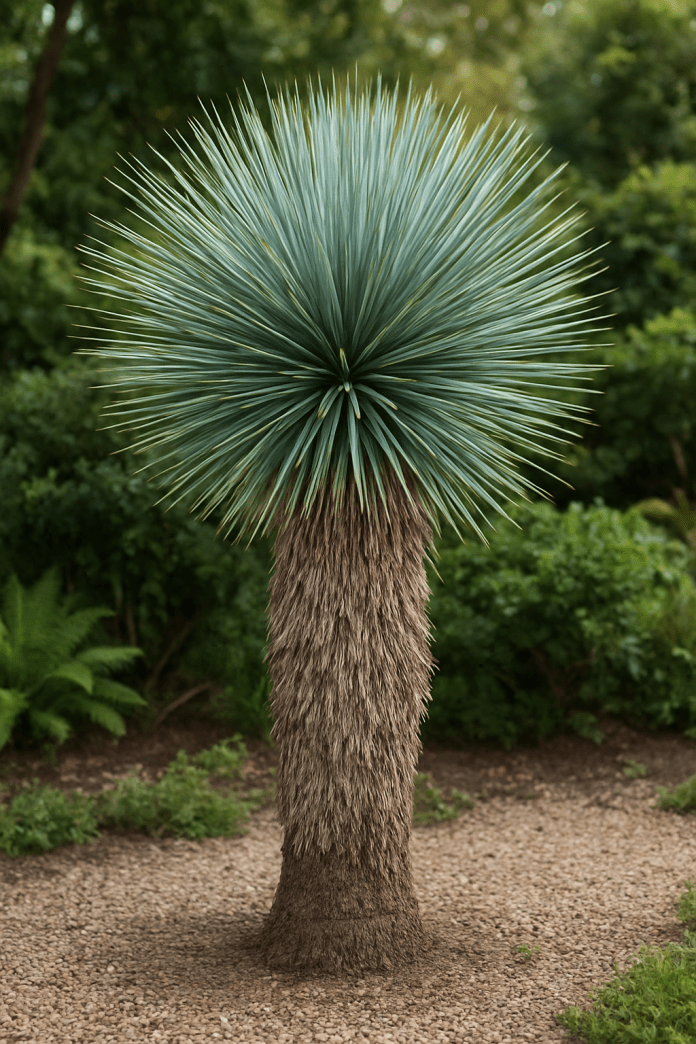
Form: Single or multi-trunked with a dense head of narrow, blue-grey leaves forming a spherical crown.
Leaves: Rigid, sword-shaped, up to 60 cm long, with a fine tip and smooth edges (unlike many other Yuccas).
Flowers: Tall panicles of white, bell-shaped blooms appearing in late spring to early summer
Description
Yucca rostrata is an elegant and hardy architectural yucca, forming a tall, slender trunk crowned with a dense globe of fine, steel-blue leaves. Each leaf is narrow and flexible with a soft tip, giving a refined look for tropical or desert-style gardens. Mature plants produce a tall flower spike with creamy-white, bell-shaped blooms in late spring or summer. Its silvery crown and trunk make it an excellent focal plant.
Growing Conditions
- Position: Full sun, south-facing and sheltered from cold winds
- Soil: Sharply drained, sandy or gritty soil; avoid heavy clay
- pH: Neutral to alkaline
- Watering: Water sparingly in summer; keep almost dry in winter
- Feeding: Light balanced fertiliser in spring; avoid rich composts
Hardiness
- Cold tolerance: Down to –15°C if kept dry
- UK suitability: Hardy in southern and coastal areas
- Winter care: Protect the crown from prolonged rain using gravel mulch or a simple shelter
Care & Maintenance
- Remove dry lower leaves as they form; leave the “skirt” for a natural look or trim for neatness
- Mulch with gravel or coarse grit for drainage
- Excellent in pots; use a cactus/succulent mix with added grit and shelter in wet winters
- Rarely affected by pests, but check for mealybugs or scale
Potting Mix for Containers
If you’re growing your Yucca in a pot, here’s a simple DIY mix:
- 2 parts gritty compost or multipurpose compost
- 1 part coarse sand
- 1 part horticultural grit or perlite
This mix drains quickly and keeps the roots happy. Make sure your container has a good drainage hole, and top with a layer of gravel or grit to reduce moisture around the crown.
Propagation
- Seed: Sow at 20–25°C in light; germination may take several weeks
- Offsets: Detach and root basal pups if produced
- Division: Not applicable; usually single-trunked
Common Problems
- Crown rot: Trapped moisture; improve drainage and protect from rain
- Leaf browning: Frost or overwatering; remove damaged leaves and reduce watering
- Root rot: Poor drainage; replant in gritty mix or raised bed
Design & Companions
- Ideal for tropical, Mediterranean, and arid-themed gardens
- Works as a feature in gravel gardens, dry borders, or modern courtyards
- Companions: Dasylirion wheeleri, Agave americana, Nolina nelsonii, Trachycarpus fortunei, Cordyline australis, hardy Aloe species
Latin Botanical Description
Yucca rostrata Engelm. ex Trel. — Arbuscula caudice lignoso solitario vel raro ramoso; foliis anguste linearibus glaucis, margine integris; inflorescentia terminali paniculata; floribus albis campanulatis; fructu oblongo rostro producto
Interesting Facts About Yucca rostrata
- Desert Survivor:
Native to the Chihuahuan Desert of northern Mexico and western Texas, it’s adapted to survive extreme droughts and intense sun. Its leaves store water and reflect sunlight with their bluish-silver color. - Architectural Shape:
Its slow-growing, single-trunked form with a dense crown makes it a natural “living sculpture” — often used as a focal point in both desert and tropical-style gardens. - Long Lifespan:
These plants can live for several decades, sometimes 50+ years in the wild. They’re truly a long-term garden investment. - Flower Spike Drama:
Mature plants produce tall, creamy-white flower spikes, often up to 1 m or more, which are not only striking but also attract pollinators like moths. - Not Just Decorative:
In its native habitat, yuccas are sometimes used for fiber — early peoples used the leaves for weaving ropes and mats. - Slow but Steady:
It’s slow-growing — often only a few centimeters a year in the UK — which means patience is key, but also makes it very low-maintenance once established. - Hardiness Surprise:
Even though it looks tropical or desert-like, it’s surprisingly cold-hardy, tolerating frosts down to –15°C if kept dry. That’s why it works in parts of the UK. - Natural Sculptural Form:
Gardeners sometimes leave the old dried leaves (“skirt”) around the trunk to give it a dramatic desert look, while others trim for a cleaner modern aesthetic. - Container-Friendly:
While it’s a “tree” in shape, it adapts very well to pots, which is perfect for patios or tropical-themed garden corners in temperate climates.
Yucca rostrata is very slow-growing, especially in climates like the UK. Here’s a detailed breakdown:
Growth Rate
- Seedling stage:
- In the first few years, it may only grow 2–5 cm per year.
- Seedlings take several years to form a noticeable trunk.
- Juvenile to mature plant:
- Once the trunk begins to form, growth picks up slightly, but you’re still looking at 5–10 cm of trunk growth per year in temperate gardens.
- Leaves expand gradually; the crown becomes dense over many years.
- Mature height:
- In the wild or very favourable conditions, it can reach 3–4 m tall, but in the UK it often takes 20–30 years to approach 2–3 m, and sometimes longer depending on soil and sun.
Tips for Encouraging Growth
- Full sun: Maximum light boosts leaf production and overall growth.
- Sharp drainage: Avoid wet winters; soggy soil slows growth and can cause rot.
- Lean soil: Too rich soil encourages leafy growth but weakens the trunk.
- Patience: Growth is slow but steady — it’s a long-term architectural plant.
Yucca rostrata – Grow Guide
Common name: Beaked Yucca
Family: Asparagaceae
Type: Evergreen succulent / small tree
Hardiness: RHS H4 – hardy in most of the UK with a sheltered position; protect from severe frost
Ultimate size: 2–4 m tall × 1–1.5 m wide
Overview
Yucca rostrata is a dramatic architectural plant native to northern Mexico and Texas. It is prized for its stiff, narrow blue-green leaves arranged in a striking spherical crown and its impressive tall flower spikes. Perfect for desert-style, tropical-themed, or Mediterranean borders in the UK. Its drought tolerance makes it ideal for low-maintenance planting.
Position
- Light: Full sun (essential for good leaf colour and flowering)
- Best in sheltered, well-draining sites
- Can be grown in large containers in colder areas to move under cover in winter
Soil
- Type: Very well-draining, sandy or gritty soil
- Avoid heavy clay that holds water
- pH: Neutral to slightly alkaline
Planting
- When: Spring or autumn in mild conditions
- Space plants 2–3 m apart for mature crowns
- Plant slightly raised in heavy soils to improve drainage
- Mulch base in winter to protect roots in colder regions
Watering
- Very drought-tolerant once established
- Water moderately during first 1–2 years
- Reduce watering in winter; avoid waterlogged soil
Feeding
- Apply a slow-release fertiliser in spring
- Minimal feeding required; too much nitrogen encourages soft growth
Growth & Habit
- Single-trunked or multi-stemmed evergreen
- Stiff, narrow, blue-green leaves in a rounded crown
- Mature plants produce tall spikes of creamy-white flowers in summer
- Slow-growing; can live for decades
Flowering
- Months: June–July (UK)
- Flowers: Creamy-white, bell-shaped, on spikes up to 2 m tall
- Attracts bees and pollinators
Maintenance
- Remove dead or damaged leaves to keep plant tidy
- Protect young plants from severe frost with fleece or cloches
- Can be container-grown for winter protection in cold areas
Propagation
- Offsets / suckers: Rare, from mature plants
- Seed: Slow-growing; may take years to flower
Pests & Problems
- Very pest- and disease-resistant
- Leaf tips may brown in damp or humid conditions
- Root rot in poorly drained soils
Garden Use
- Architectural feature in tropical, desert, or Mediterranean-style gardens
- Containers for patios or terraces in colder areas
- Excellent companion plants:
- Agave
- Dasylirion
- Cordyline australis
- Cacti and succulents
Quick Reference Table
| Feature | Details |
|---|---|
| Hardiness | RHS H4 – hardy in mild/sheltered UK gardens |
| Height | 2–4 m |
| Spread | 1–1.5 m |
| Flowering | June–July; creamy-white spikes |
| Position | Full sun; sheltered; well-draining soil |
| Soil | Very well-draining, sandy or gritty; neutral to slightly alkaline |
| Water | Moderate during establishment; drought-tolerant once established |
| Feeding | Slow-release fertiliser in spring; minimal feeding needed |
| Propagation | Offsets (rare); seed (slow) |
| Maintenance | Remove dead leaves; protect young plants from frost |
| Best feature | Architectural crown of blue-green leaves and dramatic flower spikes |