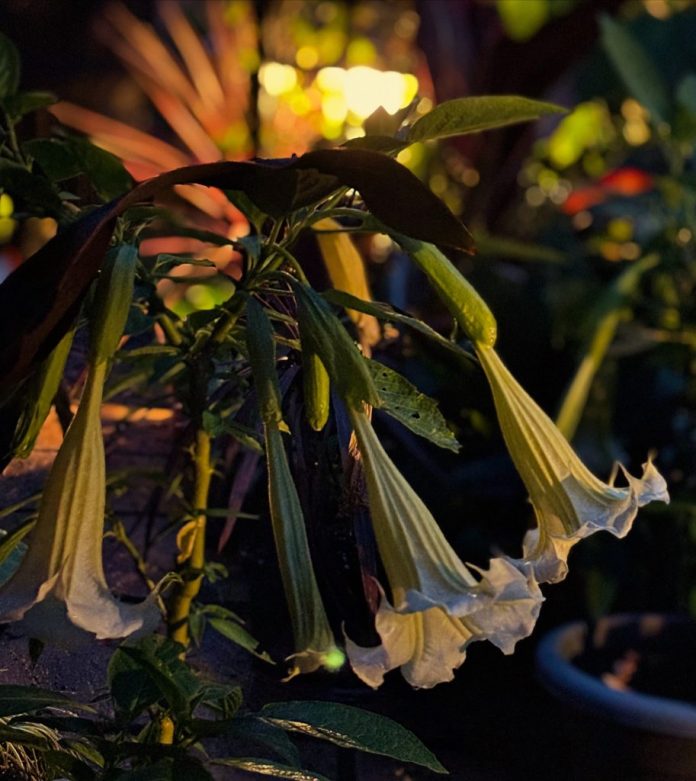
Brugmansias — often called Angel’s Trumpets — are divided into warm group and cold group species. This classification is based on their natural habitats and temperature preferences, which affect how (and where) they grow best.
Here’s a breakdown:
Warm Group Brugmansias
Native range: Lowland tropical regions of South America (mainly around the Amazon Basin, northern Andes foothills).
Preferred conditions: Warm, humid, frost-free climates; dislike temperatures below about 10°C (50°F).
Species (Warm Group):
- Brugmansia aurea – Golden Angel’s Trumpet
- Brugmansia insignis
- Brugmansia suaveolens – Common in cultivation, often the parent of many hybrids
- Brugmansia versicolor – Very large flowers, often peach or apricot
- Brugmansia × candida – A hybrid between aurea and versicolor, very common in gardens
Traits:
- Evergreen in warm climates
- Larger, lush leaves
- Typically bloom heavily in warm, humid weather
- Often grown as tender perennials or conservatory plants in the UK
Cold Group Brugmansias
Native range: Higher altitudes of the Andes, from Colombia down to Chile.
Preferred conditions: Cooler mountain climates; tolerate light frost and cooler nights.
Species (Cold Group):
- Brugmansia sanguinea – Red or orange-red flowers, little to no fragrance
- Brugmansia vulcanicola – Smaller, tubular flowers; prefers cool conditions
- Brugmansia arborea – White, trumpet-shaped flowers; hardy down to around –2°C (28°F) for short periods
Traits:
- More deciduous in cold weather
- Prefer cooler, moister air
- Less tolerant of heat and humidity
- Often bloom better in cool summers
In the UK
- Warm group Brugmansias do best in greenhouses, conservatories, or sheltered patios in summer, overwintered indoors.
- Cold group species can be tried outdoors in very sheltered gardens, particularly in mild coastal or Cornish conditions, but still need frost protection.
Brugmansia Warm Group vs Cold Group
| Feature | Warm Group Brugmansias | Cold Group Brugmansias |
|---|---|---|
| Native habitat | Lowland tropical regions of South America – mainly around the Amazon Basin and northern Andes foothills | Highland Andean regions – cool, moist mountain slopes |
| Climate preference | Warm, humid, frost-free | Cool, mild, can tolerate light frost |
| Temperature tolerance | Sensitive below 10 °C (50 °F); must be overwintered frost-free | Some species tolerate brief dips to –2 °C (28 °F) |
| Growth habit | Evergreen in warmth; lush, large leaves | Semi-deciduous to deciduous in cool weather |
| Typical flower form | Large, flared trumpets up to 30 cm long | Smaller, narrower, more tubular trumpets |
| Flower colour | White, cream, yellow, pink, peach, apricot | Orange, red, scarlet, or bicoloured (less fragrant) |
| Fragrance | Strong, sweet scent – especially evenings | Often little or no fragrance |
| Blooming season | Best in hot, humid weather | Best in cool summer or autumn conditions |
| Notable species | Brugmansia aurea, B. insignis, B. suaveolens, B. versicolor, B. × candida | Brugmansia sanguinea, B. vulcanicola, B. arborea |
| UK cultivation | Summer outdoors or in conservatory; overwinter indoors | Can be tried outdoors in very mild, sheltered gardens with frost protection |
| Use in hybridising | Many modern hybrids derive from this group | Used to introduce cold tolerance and colour intensity |