
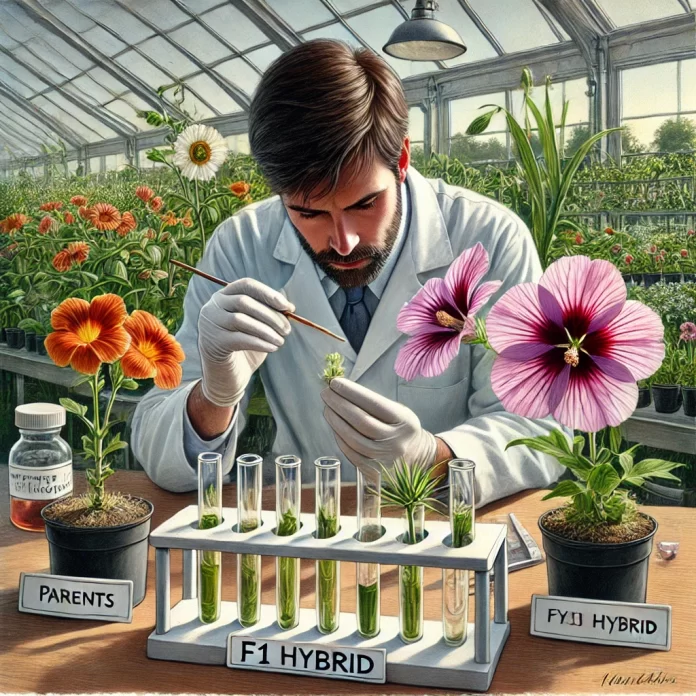
In the world of gardening and horticulture, the term F1 hybrid often comes up when discussing seeds and plants, but what does it actually mean? Understanding F1 hybrids can help gardeners make more informed decisions about what to plant in their gardens, whether you’re growing vegetables, flowers, or fruit.
What Is an F1 Hybrid?
An F1 hybrid, short for “Filial 1 hybrid,” is the first-generation offspring resulting from the cross-pollination of two genetically distinct parent plants. These parent plants are chosen for their desirable traits, such as disease resistance, vigor, uniformity, or higher yields. By crossing these plants, breeders create seeds that produce offspring with the best qualities of both parents.
For example, if one parent plant is particularly resistant to blight and another has a high yield of fruit, their F1 hybrid offspring may inherit both traits, resulting in a plant that is both productive and disease-resistant.
Benefits of F1 Hybrids
- Vigor
F1 hybrids are known for hybrid vigor (heterosis), which means they often grow faster, stronger, and healthier than their parent plants. This makes them ideal for gardeners looking for robust plants. - Uniformity
One of the standout features of F1 hybrids is their uniformity. Plants grown from F1 seeds tend to look and perform consistently, making them popular for commercial growers who need predictability in their crops. - Improved Traits
F1 hybrids are bred to have specific desirable traits, such as:- Disease resistance
- Drought tolerance
- Better taste or appearance
- High productivity
- Shorter Growing Periods
Many F1 hybrids mature more quickly, allowing gardeners to harvest crops sooner or grow in shorter growing seasons.
Challenges of F1 Hybrids
- Cost
Producing F1 hybrid seeds is a labor-intensive and time-consuming process. As a result, these seeds are often more expensive than open-pollinated or heirloom varieties. - Non-Saving of Seeds
Seeds collected from F1 hybrid plants do not reliably produce plants identical to the parent. The offspring (F2 generation) often display a mix of traits, many of which may be inferior or less predictable. For gardeners who like to save seeds, F1 hybrids are not ideal. - Limited Genetic Diversity
F1 hybrids are genetically uniform, which can be a disadvantage in some cases. If a new pest or disease emerges, the entire crop may be susceptible due to the lack of genetic variation.
F1 Hybrids vs. Heirloom Varieties
F1 hybrids differ significantly from heirloom varieties, which are open-pollinated plants with stable traits passed down through generations. Heirlooms are prized for their rich flavors, adaptability, and ability to produce true-to-type seeds. However, they may lack the vigor or uniformity of F1 hybrids.
When to Choose F1 Hybrids
F1 hybrids are an excellent choice if you:
- Want reliable performance and uniformity.
- Need specific traits like disease resistance or a compact growth habit.
- Grow crops in challenging conditions, such as areas with poor soil or short growing seasons.
When you breed from an F1 hybrid (the first-generation offspring of two distinct parent plants), the seeds produced will result in a second-generation, or F2, population. Unlike the uniformity of the F1 generation, the F2 generation typically displays significant genetic variation. Here’s why this happens and what you can expect:
1. Loss of Uniformity
F1 hybrids are specifically bred for their consistent traits, such as size, flavor, or disease resistance. In the F2 generation, the genetic traits of the parent plants (the original parents of the F1 hybrid) are reshuffled. This means the offspring may inherit a random combination of traits, often resulting in a wide range of characteristics. For example:
- Some F2 plants may resemble one of the original parent plants more than the other.
- Other plants may display unexpected or undesirable traits, such as smaller yields, weaker growth, or reduced disease resistance.
2. Segregation of Traits
This loss of uniformity occurs because F1 hybrids are heterozygous, meaning their genetic makeup contains different alleles for specific traits. When the F1 plant produces seeds, these alleles segregate during reproduction, following Mendelian genetics. This can result in:
- Some F2 plants expressing dominant traits from the F1 hybrid.
- Others expressing recessive traits that were masked in the F1 generation.
For example, if one parent of the F1 hybrid contributed disease resistance, not all F2 plants may inherit this trait, leaving some more susceptible to pests or diseases.
3. Unpredictability in Yield and Performance
The vigor and uniformity seen in F1 hybrids (known as hybrid vigor) often disappear in the F2 generation. Without controlled breeding, F2 plants can:
- Exhibit weaker growth or reduced yields.
- Show variability in fruit or flower size, shape, and quality.
- Lack resilience to environmental stress or pests compared to their F1 parents.
4. Potential for New Varieties
Despite the unpredictability, breeding from F1 hybrids can be a valuable process if you are willing to experiment and select desirable traits over several generations. Over time, this can lead to the development of a stable open-pollinated variety. However, this requires patience and careful selection:
- Save seeds only from plants with the traits you want to preserve.
- Grow these seeds over multiple generations, continuing to select the best performers until the traits become consistent (a process that can take 6–10 generations).
5. When to Avoid Saving Seeds from F1 Hybrids
If you’re growing crops where reliability, uniformity, and high performance are crucial (e.g., commercial farming), saving seeds from F1 hybrids is not recommended. The F2 generation’s unpredictability can result in poor harvests or inconsistent traits.
Summary
Breeding from F1 hybrids leads to F2 plants with diverse and often unpredictable traits. While the process can be fascinating and may eventually yield unique results, it requires time, effort, and a willingness to work through the genetic variability. If uniformity and reliability are your priorities, it’s best to stick with fresh F1 hybrid seeds rather than saving seeds from them.
Conclusion
F1 hybrids represent a marvel of modern plant breeding, offering gardeners plants with improved traits and reliability. However, they are not always the best choice for those who prioritize seed saving or preserving genetic diversity. By understanding their benefits and limitations, you can decide when and where F1 hybrids fit into your gardening plans. Whether you opt for F1 hybrids, heirlooms, or a mix of both, the key is to choose plants that suit your needs and growing conditions.