
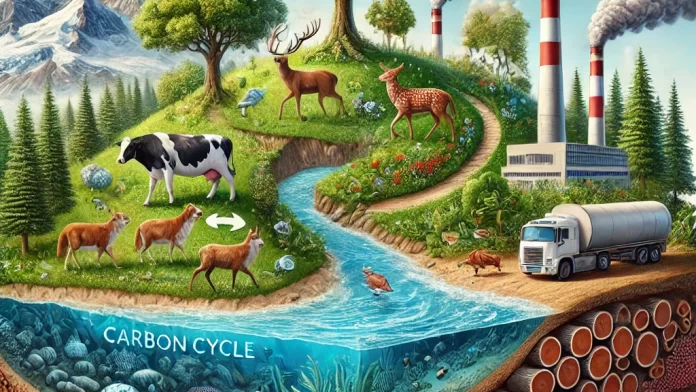
The carbon cycle is a continuous process that describes the movement of carbon through Earth’s major systems: the atmosphere, biosphere, lithosphere, and hydrosphere. These systems interact dynamically, with carbon atoms transitioning between them through various natural processes. Below, we explore these movements and how they maintain balance in the global ecosystem.
How Carbon Moves Between Systems
1. Atmosphere to Biosphere: Photosynthesis
- Plants, algae, and cyanobacteria absorb carbon dioxide (CO₂) from the atmosphere during photosynthesis.
- Using sunlight, these organisms convert CO₂ and water into glucose (a sugar) and oxygen, incorporating carbon into organic matter.
- Example: A forest absorbs atmospheric CO₂ and locks it in leaves, stems, and roots.
2. Biosphere to Atmosphere: Respiration
- Plants, animals, and microorganisms release CO₂ back into the atmosphere during respiration.
- Carbon stored in organic molecules is broken down to provide energy, releasing CO₂ as a byproduct.
- Example: A deer breathes out CO₂ as it metabolizes the plants it eats.
3. Biosphere to Lithosphere: Burial and Fossilization
- Dead plants and animals, along with their waste products, are decomposed by microorganisms.
- Some of this material becomes buried over time, eventually forming fossil fuels like coal, oil, and natural gas.
- Example: Ancient forests buried under sediment millions of years ago transformed into coal deposits.
4. Atmosphere to Hydrosphere: Ocean Uptake
- Oceans absorb CO₂ directly from the atmosphere. The gas dissolves in surface waters, forming carbonic acid (H₂CO₃).
- Marine organisms, like corals and shellfish, use dissolved carbon to build calcium carbonate (CaCO₃) shells and skeletons.
- Example: Phytoplankton absorb CO₂ during photosynthesis in the ocean’s upper layers.
5. Hydrosphere to Atmosphere: Ocean Release
- Oceans also release CO₂ back into the atmosphere, particularly in warmer waters where gases are less soluble.
- Example: Coastal regions with upwelling currents release significant amounts of CO₂.
6. Lithosphere to Atmosphere: Combustion
- Human activities, such as burning fossil fuels, release carbon stored in the lithosphere into the atmosphere as CO₂.
- Natural processes, like volcanic eruptions, also contribute.
- Example: A coal-fired power plant emits CO₂ into the atmosphere.
7. Lithosphere to Hydrosphere: Weathering
- Carbon in rocks and minerals is released into rivers and oceans through chemical weathering.
- This process transports carbon into the hydrosphere, where it can be stored or absorbed by marine organisms.
- Example: Carbonic acid in rainwater breaks down limestone, releasing dissolved carbon.
8. Biosphere to Hydrosphere: Decomposition in Water
- Dead marine organisms decompose, releasing carbon into the ocean’s water column or trapping it in sediments.
- Example: A fish dies and its carbon becomes part of the seabed sediment.
The Flow of Carbon Across Systems
The movement of carbon between these systems can be summarized as follows:
- Atmosphere ↔ Biosphere
- Photosynthesis absorbs carbon, while respiration and decomposition release it.
- Atmosphere ↔ Hydrosphere
- Carbon dioxide dissolves into oceans, and warmer waters release CO₂ back into the atmosphere.
- Atmosphere ↔ Lithosphere
- Volcanic eruptions release CO₂, while rock weathering captures it.
- Biosphere ↔ Lithosphere
- Dead organisms form fossil fuels over millions of years.
- Biosphere ↔ Hydrosphere
- Marine organisms exchange carbon with the water around them through growth, death, and decomposition.
- Hydrosphere ↔ Lithosphere
- Sedimentation traps carbon in ocean floors, creating new rock layers over time.
The Role of Humans in Altering Carbon Movement
Humans have accelerated certain parts of the carbon cycle, especially:
- Burning Fossil Fuels: Releases carbon stored in the lithosphere into the atmosphere.
- Deforestation: Reduces the biosphere’s ability to absorb CO₂ from the atmosphere.
- Agriculture: Livestock releases methane (CH₄), and soil disruption releases carbon.
- Ocean Impacts: Increased atmospheric CO₂ leads to greater ocean uptake, causing acidification.
Why Understanding Carbon Movement Matters
The carbon cycle ensures that carbon is continuously recycled and available for life processes. However, human-induced changes have disrupted its natural flow, leading to an increase in atmospheric CO₂ levels and contributing to global warming.
To mitigate these impacts, we can:
- Reduce fossil fuel consumption to slow CO₂ emissions.
- Protect forests and restore degraded lands to enhance carbon absorption.
- Invest in technologies that capture and store carbon effectively.
By understanding how carbon moves between systems, we gain insight into maintaining the delicate balance necessary for life on Earth.