
The Newspaper For Gardeners

December Gardening Tips From...

Ooohhhhh …it's nearly here…Christmas! A time for cosy evenings by the fire and...

Looking Out for Hedgehogs...

Hedgehogs are some of the most endearing creatures in our gardens, but winter...

Protecting Your Plants from...

Winter can be a challenging time for gardeners, particularly when wildlife like deer...

Winter Compost: Digging Out...

Winter is an excellent time to dig out your compost heap and spread...
Tuesday, December 23, 2025
HomeDiscoverThe Age of...

The Age of Plants – The Devonian Period

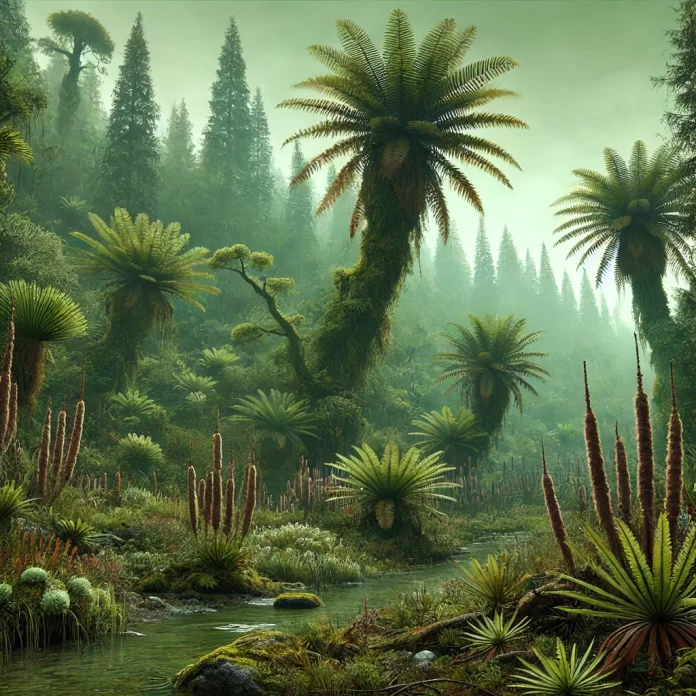
We’re going back in time to one of the most transformative chapters in plant history—the Devonian Period, also known as the ‘Age of Plants.’ This was the era when plants took over the land, developed new adaptations, and forever changed Earth’s ecosystems.


Setting the Stage

Let’s start by imagining the Earth 419 million years ago. At the beginning of the Devonian, the land was still barren and rocky in many places, dotted with mosses, liverworts, and a few other primitive plants. But by the end of this period, lush green landscapes had transformed the planet. What happened in these 60 million years was nothing short of extraordinary.

So, what made the Devonian so special? Well, this was when plants evolved vascular systems—essentially plumbing inside their tissues—that allowed them to grow taller and larger. Think of vascular tissue as the highways plants use to transport water and nutrients. This was revolutionary because it gave plants the strength to stand upright, reach for sunlight, and thrive in drier environments.


The Rise of Early Forests

As plants became more sophisticated, they started to dominate the land. The first true trees, like *Archaeopteris*, appeared during the Devonian. These trees looked like a mix of ferns and conifers, with woody trunks and fern-like leaves. *Archaeopteris* was a game-changer—it grew up to 30 feet tall and formed some of the earliest forests.

These forests didn’t just change the landscape; they changed the atmosphere. By photosynthesizing, they pulled huge amounts of carbon dioxide out of the air and released oxygen, helping to cool the planet and create the oxygen-rich atmosphere we rely on today.


The Evolution of Roots and Seeds

Another Devonian breakthrough was the evolution of roots and seeds. Before this, plants had shallow rhizoids that didn’t penetrate deeply into the ground. But during the Devonian, plants developed true roots, which anchored them firmly and allowed them to access water and nutrients deep in the soil. This helped plants spread to new areas, even ones with poor soils.

And then there were seeds—tiny capsules of life that could survive harsh conditions and travel long distances. Unlike spores, seeds had protective coatings and food reserves, giving them a much better chance of survival. This was another step toward plants dominating the land.


The Impact on Life and Ecosystems

So what did all this mean for life on Earth? The rise of plants during the Devonian didn’t just transform the land; it also had a profound impact on other organisms. Plants created habitats for the first land-dwelling animals, including early insects and arthropods. They also changed the chemistry of the oceans. As plants pulled nutrients from the soil and deposited them into waterways, it sparked a boom in marine life.

But there was a dark side to all this success. The end of the Devonian saw a series of extinction events, partly caused by the spread of forests. As plants took over, they altered ecosystems so drastically that some species couldn’t adapt.


Why the Devonian Matters to Gardeners

The Devonian Period might seem like ancient history, but its lessons are still relevant today. For gardeners, the innovations of the Devonian—roots, seeds, and vascular systems—are the foundation of modern plants. Every tree you plant, every flower you grow, traces its ancestry back to this era.

And let’s not forget the importance of forests in combating climate change. Just as Devonian plants helped cool the planet millions of years ago, the trees we plant today can help restore balance to our atmosphere.


Closing

The Devonian Period was truly the ‘Age of Plants,’ a time when the world turned green and life on land took its first big steps toward complexity. It’s incredible to think that the plants we see today, from towering oaks to tiny daisies, owe their existence to the innovations of this ancient era.

Thanks for joining me on this journey back in time. In our next episode, we’ll explore the Carboniferous Period, when plants reached their peak in size, and swamps covered the Earth. Until then, keep digging, keep planting, and remember—every plant has a story as old as time itself.
spot_img

lOOKING FOR MORE WORK?

The free and easy way to get more customers. Just join Find Local Gardeners.

Garden mazes and labyrinths have a long and fascinating history, appearing in ancient myths, religious sites, and grand estates across Europe. While they were...
🌿 Amazing Aphid Facts You Might Not Know! 🐜✨ Aphids—tiny but mighty! These little sap-suckers might be a gardener’s headache, but they have some fascinating...
Grafting is an ancient horticultural technique that allows gardeners to combine the best traits of different plants, creating stronger, more productive specimens. While most...
Clay soil can be both a blessing and a curse in the garden. It’s rich in nutrients and holds moisture well, but poor drainage...
Have you ever bitten into a chilli pepper and felt like your mouth was on fire? That burning sensation isn’t actual heat—your brain is...

Defra Ministers appoint Sir Andrew Steer as Chair of the Board of Trustees of the Royal Botanic Gardens, Kew 

Monday, 22 December 2025 Sir Andrew Steer, a prominent global leader in sustainable development and climate change has been announced as the new Chair of RBG Kew, taking over from Dame Amelia Fawcett who held the post for two terms.    Sir Andrew’s appointment is for four years and...

BigPlantPots: Bold Design, Built for Growing Big

As gardeners continue to embrace statement planting and flexible outdoor design, one UK brand is helping both professionals and home growers think bigger. BigPlantPots specialises in oversized plant containers that combine strong visual design with serious growing capacity, making...

Green-tech ends the year on a high by surpassing its charity target for St Leonard’s Hospice

Green‑tech is delighted with the success of its 2025 charity fundraising campaign for St Leonard’s Hospice, York. Their efforts have raised over £1,600. Green‑tech is the UK’s leading landscape provider, supplying products that help create greener, more resilient and biodiverse spaces...

Conservation of Scotland’s rarest moss boosted by Air-Pot® innovation

THE TEAM at Royal Botanic Garden Edinburgh (RBGE) has been able to successfully cultivate one of Scotland’s rarest mosses – Round‑leaved bryum – during ex‑situ conservation trials with the help of Air-Pot® (December 2025). The Air-Pot container’s innovative design, which...

Continue reading

Defra Ministers appoint Sir Andrew Steer as Chair of the Board of Trustees of the Royal Botanic Gardens, Kew 

Monday, 22 December 2025 Sir Andrew Steer, a prominent global leader in sustainable development and climate change has been announced as the new Chair of RBG Kew, taking over from Dame Amelia Fawcett who held the post for two terms.    Sir Andrew’s appointment is for four years and...

BigPlantPots: Bold Design, Built for Growing Big

As gardeners continue to embrace statement planting and flexible outdoor design, one UK brand is helping both professionals and home growers think bigger. BigPlantPots specialises in oversized plant containers that combine strong visual design with serious growing capacity, making...

Green-tech ends the year on a high by surpassing its charity target for St Leonard’s Hospice

Green‑tech is delighted with the success of its 2025 charity fundraising campaign for St Leonard’s Hospice, York. Their efforts have raised over £1,600. Green‑tech is the UK’s leading landscape provider, supplying products that help create greener, more resilient and biodiverse spaces...

SUBSCRIBE TO OUR YOUTUBE CHANNEL

Plant advice for unusual species plus updates from our tropical garden

SUBSCRIBE