Red squirrel range in Highlands increases by over 25% following major reintroduction project by rewilding charity
The range of red squirrels in the Scottish Highlands has increased by more than 25% following a 10-year reintroduction project by rewilding charity Trees for Life.
Surveys show that over a dozen new populations of reds are now thriving and breeding successfully – with many spreading and linking up, and others likely to do so in future.
Following the latest reintroductions this year, Trees for Life has so far relocated 259 red squirrels to 13 new sites in the northwest Highlands from which the species was missing.
Reds are now present as far north as Ullapool and Brora, at multiple locations on the northwest coast, at Morvern to the southwest, and across all areas of suitable habitat in the central Highlands as far north as Lairg, Trees for Life’s latest survey found.
“This rewilding success story is offering hope for the long-term survival of Scotland’s much-loved red squirrels, and shows how we can make a real and positive difference to our native wildlife,” said Trees for Life’s Becky Priestley.
The charity now plans to expand the species’ range further as part of an ambitious new Missing Species Programme for the Highlands, which it is to launch to bring back four of Scotland’s keystone animals which are partly or fully missing from Scotland.
Although an iconic Scottish species, the red squirrel was brought to the edge of extinction in Britain by historic habitat loss and human persecution. Its recovery remains at risk due to competition from the non-native grey squirrel, which also carries the fatal squirrel pox virus.
During the NatureScot-licensed reintroductions, Trees for Life carefully relocates small numbers of reds from healthy populations around Inverness-shire, Moray and Strathspey to suitable woods in the north and northwest, where they will be safe from greys. Red squirrels can’t reach these havens without help, because they avoid crossing large open spaces.
The latest releases this year saw 12 reds reintroduced to woodlands along the coast from Letterfearn to Ratagan on the Glenelg peninsula, to bolster the population after seven squirrels were released the previous autumn.
Estimates of UK numbers of reds range from just 160,000 to 287,000. Scotland is today the British stronghold for the woodland-loving species – home to 80% of the population.
Before the reintroductions, reds were absent from most of their former range in the north and northwest Highlands, with the last records generally from the 1970s. Trees for Life’s surveys show reintroductions have been highly successful, already increasing the Highland red squirrel range by more than 26%.
Prior consultations are carried out at each release site. Only a few reds are relocated from each donor site to leave those populations unaffected, and these sites are regularly changed to ensure genetic diversity. Checks ensure only healthy animals are relocated.
With animal welfare paramount, the reds are transported in hay-lined nest boxes and released into habitat with plenty of natural food and shelter. Additional food is provided for several months as the reds get used to their new habitat.
Since launching the project in 2015, Trees for Life has established new populations of reds in Shieldaig, Coulin, Plockton, Inverewe, Reraig, Attadale, Letterewe, Lochaline, Spinningdale, Golspie, Arisaig, Drimnin, and Ratagan.
Combined with the previous work of the Roy Dennis Wildlife Foundation, which pioneered the reintroductions to three other sites, in total more than 340 red squirrels have been relocated to 16 new sites in the Highlands since 2008.
“Our local community volunteers have been at the heart of this project – from identifying donor sites, to helping with supplementary feeding and taking part in citizen science by reporting sightings and monitoring camera traps,” said Becky Priestley.
A detailed new red squirrel distribution map for the Highlands to inform future restoration initiatives has been created by the charity. This draws on citizen science sightings, data from organisations and landowners, and a new way of analysing squirrel feeding evidence.
Trees for Life’s surveys also highlighted the benefits of reforestation, and how further woodland restoration could help some isolated populations of reds to spread. Squirrel reintroductions in turn help forests naturally expand, because reds plant new trees by forgetting where they have buried their winter stores of nuts and seeds.
In November, Trees for Life announced it is to launch a £3.6m Missing Species Programme for the Highlands, focused on red squirrels, lynx, beavers, and modern-day aurochs. Alongside a supporter appeal to raise an initial £25,000 to kickstart the initiative, Trees for Life is reaching out to major funders to help resource the ambitious new programme.
See treesforlife.org.uk/missing-species for more details.
Source Richard Bunting, Trees For Life
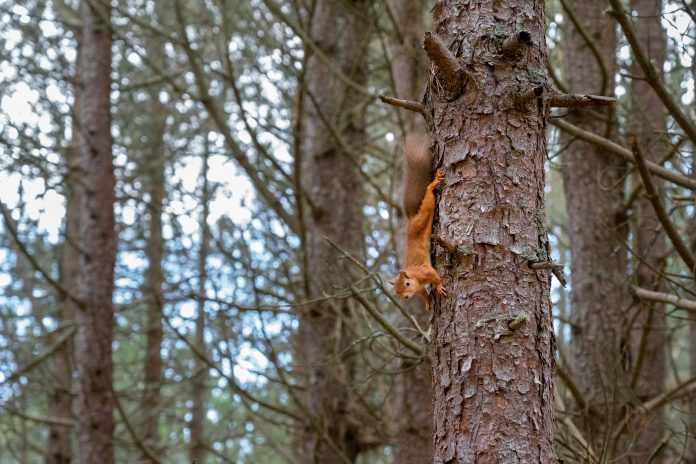
Photo credit Red squirrel climbing down tree – Chris Aldridge