Today, we’re exploring the remarkable journey of Marianne North, a Victorian-era artist and plant collector who traveled the world to document exotic plants in her vibrant paintings.
Her work not only captured the beauty of plants but also helped advance botanical understanding. So, who was this adventurous artist, and how did her work shape the world of horticulture?
Who Was Marianne North?
Born in 1830 in Hastings, England, Marianne North was no ordinary Victorian woman. While many women of her time were confined to domestic life, North pursued a life of adventure, driven by a passion for art and nature.
Her love for plants began in her father’s garden, but it was his death in 1869 that pushed her to travel. She decided to document the world’s flora, combining her skills as a painter with her curiosity about plants.
Armed with her brushes and paints, she embarked on a journey that would take her to over 15 countries, including India, Japan, Brazil, and Australia. She wasn’t just an artist; she was a pioneer, traveling to places where few women – or men – dared to go.
Her Unique Contribution
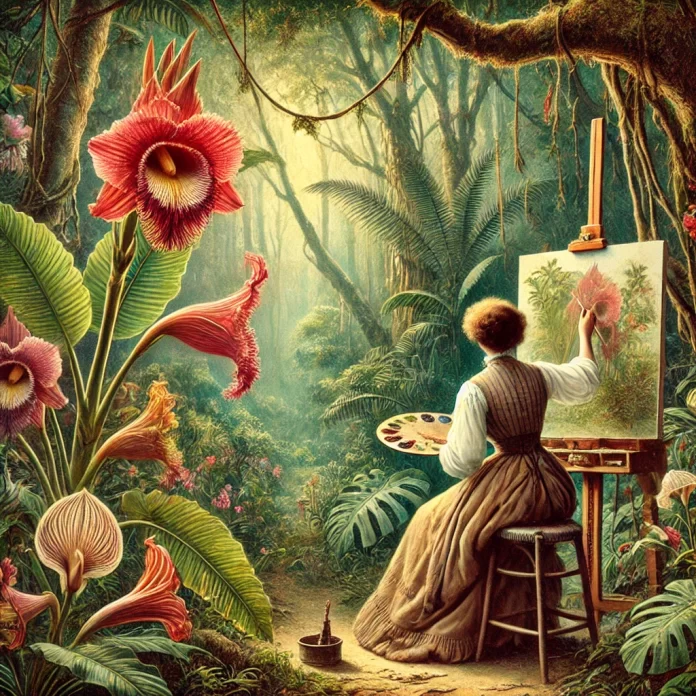
What set Marianne North apart was her ability to capture plants in their natural habitats. Unlike botanical illustrations of the time, which focused on scientific accuracy, her paintings showed plants in their ecosystems.
One of her most famous works features the giant Rafflesia arnoldii, the world’s largest flower, which she painted while in Borneo. She also captured stunning landscapes, from the Amazon rainforest to the Australian outback. Her vivid paintings brought these exotic plants to life for people who might never see them otherwise.
North wasn’t just an artist; she was also a plant collector. Many of the species she painted were sent back to Kew Gardens, where scientists used her work to identify and study them. In fact, several plants, including Northia seychellana, were named in her honor.
Challenges and Triumphs
Traveling as a single woman in the 19th century was no easy feat. North faced extreme climates, illness, and the dangers of remote locations. But she was undeterred. She once described herself as ‘intensely happy in the jungles.
Her resilience was matched by her generosity. In 1882, she donated 833 of her paintings to Kew Gardens, along with the funds to build the Marianne North Gallery. This gallery remains a treasure trove of botanical art, showcasing her life’s work and inspiring generations of gardeners and scientists.
Marianne North’s Legacy
Today, Marianne North is celebrated as one of the great pioneers of botanical art. Her work bridges the worlds of science and art, offering a glimpse into the natural beauty of the 19th century.
When you visit the gallery at Kew, you’re not just seeing paintings – you’re stepping into the legacy of a woman who defied the conventions of her time to share the wonders of the plant world.
Marianne North’s story is a reminder that passion and determination can lead to extraordinary achievements. So, next time you’re in your garden, think about the incredible journeys behind the plants we cherish.
Closing Remarks
Don’t forget to subscribe for more stories about the people and plants that shaped our world. Until next time, happy gardening!