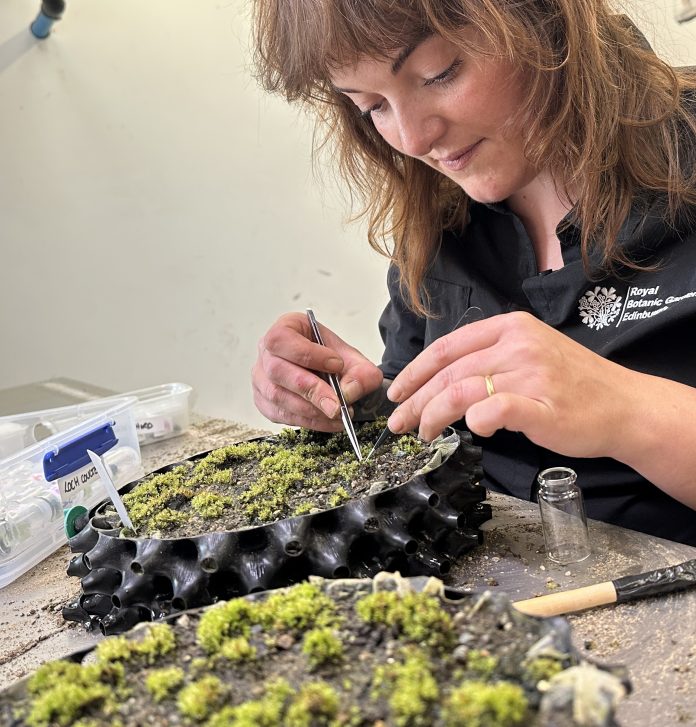
THE TEAM at Royal Botanic Garden Edinburgh (RBGE) has been able to successfully cultivate one of Scotland’s rarest mosses – Round‑leaved bryum – during ex‑situ conservation trials with the help of Air-Pot® (December 2025).
The Air-Pot container’s innovative design, which allows precise water management and oxygenation, has enabled trials of this challenging species to go ahead.
Rebecca Drew Galloway, Scottish Native Plant Conservation Horticulturist at RBGE says: “Working with Air-Pot® has proved a brilliant breakthrough for us. Its aerating design can replicate complex natural habitats and support propagation of species previously considered almost impossible to grow other than in the wild.”
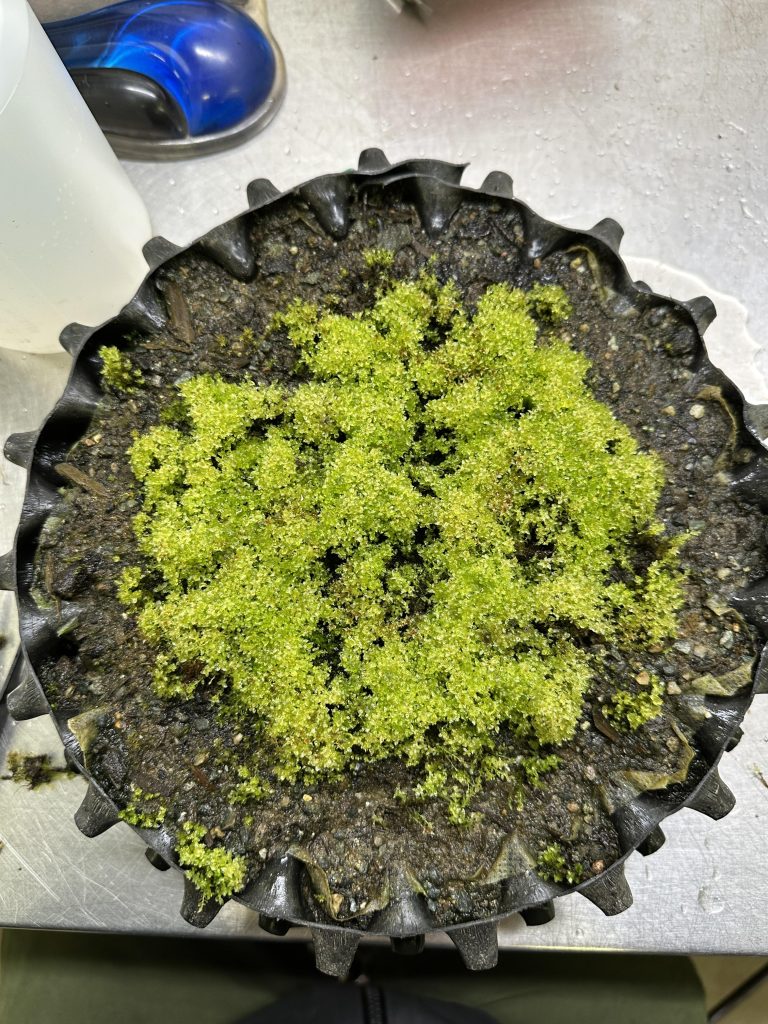
The moss, historically confined to the muddy edge of a single reservoir, required conditions of sandy mud with variable water submergence.
RBGE horticulturists and conservationists, in collaboration with NatureScot and Scottish Water, needed to determine precise tolerances for moisture and depth – work made possible by the Air-Pot® container’s adjustable base system, which allowed fine control of water levels without compromising stability.
Rebecca adds: “Air-Pot® modularity lets us manipulate conditions for species that have never been cultivated before. For Round‑leaved bryum, the ability to raise or lower the base and maintain oxygenation was critical.”
Air-Pot containers are engineered for root health, aeration and adaptability, making them ideal for nurseries, research facilities, and conservation projects where precision and flexibility are paramount.
Georgie Single, Marketing & Sales Representative at Air-Pot® in Edinburgh, explains: “Our Air-Pot system gives horticultural professionals complete control and flexibility. Our modular bases allow precise water management, outperforming traditional pots.
“The perforated walls promote aeration and water movement, reducing the risk of anaerobic conditions. Plus, the easy-to-cut panels mean growers can create bespoke profiles for species-specific needs, while the design makes opening the containers up for root inspection simple without disturbing the plant. It’s a game-changer for anyone working with challenging or rare species.”
The Air-Pot® adaptability also enabled Rebecca to create large, shallow profiles ideal for moss maintenance, while retaining surface area for growth.
This success forms part of RBGE’s wider strategy to propagate, trial and bulk up native rare species in ex‑situ collections, with the goal of reintroducing plants to the wild and establishing self‑sustaining populations.
Rebecca continues: “I work with Air-Pot® a lot and they are my top choice for their intended use such as trees or to encourage lateral root growth. But what I really love about them is their modularity. As we are often working with plants that have never been cultivated, we are creating and developing protocols that have never been done before, and Air-Pot® have the benefit of being manipulatable.
“Here at the nursery, we endeavour to re-create artificial natural growing conditions for a wide range of species for trial work and bulking up our collection, and modularity of a product has a huge benefit for our work.”
The containers are also more eco-friendly than other pots. They are manufactured with the minimum possible environmental impact using recycled plastic and are sturdy and reusable many times over, even in intense sunshine. Many customers have the same pot they have been reusing for 10 to 15 years.
For further details, please visit www.air-pot.com/nursery/.
Source Rachel Burks, Porcupine PR