
Berry
Overview:
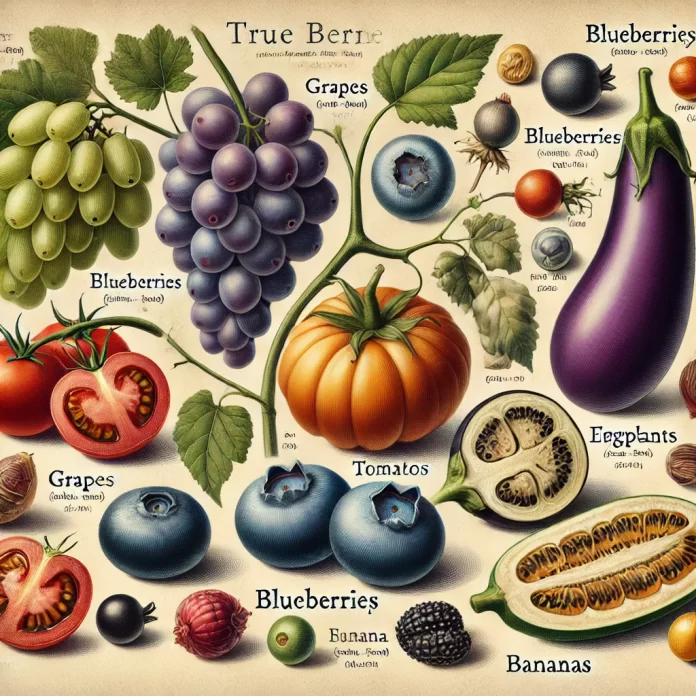
A berry is a type of simple, fleshy fruit that typically develops from a single ovary and contains one or more seeds embedded within the pulp. In botanical terms, a berry is classified as an indehiscent fruit (one that does not split open at maturity) and is characterized by a soft pericarp (fruit wall) without a hard pit or shell. While many fruits commonly called “berries” in everyday language—such as strawberries, raspberries, and blackberries—are not true berries by botanical definition, others, such as tomatoes, bananas, and grapes, meet the criteria.
Botanical Characteristics:
- Pericarp Structure: Composed of three layers—exocarp (outer skin), mesocarp (fleshy middle), and endocarp (inner layer surrounding seeds)—all of which remain soft at maturity.
- Seed Arrangement: Seeds are typically dispersed throughout the flesh rather than contained within a central stone or shell.
- Development: Arises from a single ovary of a single flower and does not split open at maturity.
Types of True Berries:
- Simple Berries:
- Tomato (Solanum lycopersicum)
- Grape (Vitis vinifera)
- Blueberry (Vaccinium spp.)
- Eggplant (Solanum melongena)
- Banana (Musa spp.)
- Modified Berries:
- Hesperidium: A berry with a leathery rind, e.g., orange (Citrus sinensis), lemon (Citrus limon).
- Pepo: A berry with a tough outer rind, e.g., cucumber (Cucumis sativus), watermelon (Citrullus lanatus), pumpkin (Cucurbita spp.).
Common Misconceptions (Non-Botanical “Berries”):
- Aggregate Fruits:
- Strawberry (Fragaria × ananassa)—an aggregate of multiple achenes on a fleshy receptacle.
- Raspberry (Rubus idaeus) & Blackberry (Rubus fruticosus)—composed of multiple drupelets from a single flower.
- Drupelets (Stone Fruits):
- Cherry (Prunus avium), Olive (Olea europaea), and Plum (Prunus domestica) are drupes, not berries, because they contain a hard, single stone.
Ecological and Culinary Importance:
- Wildlife: Berries serve as a primary food source for birds, mammals, and insects, playing a crucial role in seed dispersal.
- Human Consumption: Used fresh, dried, or processed in jams, juices, and desserts. Rich in vitamins, antioxidants, and dietary fiber.
- Cultural Significance: Many indigenous and ancient civilizations revered berries for their medicinal and nutritional properties.
Evolutionary Adaptations:
- Bright colors and high sugar content attract animals for endozoochory (seed dispersal via digestion).
- Soft, fleshy texture facilitates easy consumption and digestion.
Berries, in both their botanical and culinary forms, remain one of the most diverse and ecologically significant fruit types, bridging science, nutrition, and culture in a single, delicious package.