
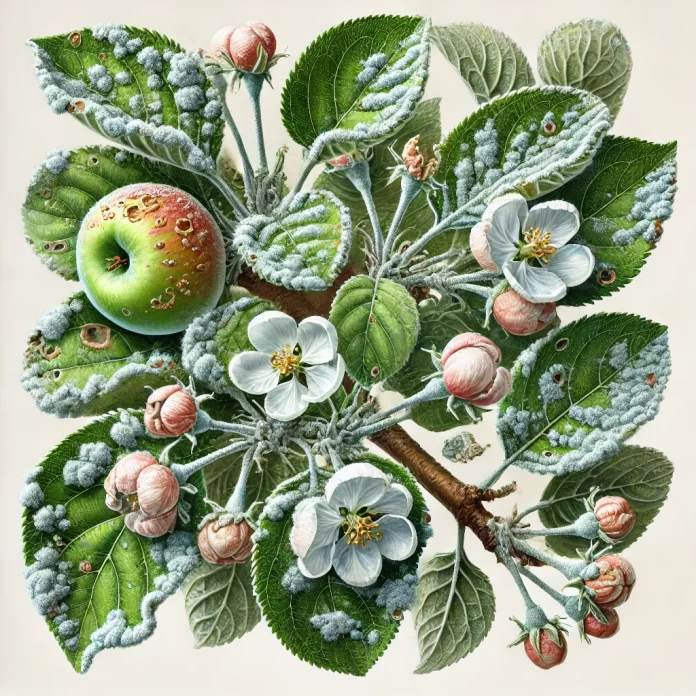
Apple Powdery Mildew (Podosphaera leucotricha)
Taxonomy:
- Kingdom: Fungi
- Phylum: Ascomycota
- Class: Leotiomycetes
- Order: Erysiphales
- Family: Erysiphaceae
- Genus: Podosphaera
- Species: P. leucotricha
Description:
Apple powdery mildew (Podosphaera leucotricha) is a fungal pathogen that affects apple (Malus domestica), pear (Pyrus spp.), and related Rosaceae species. It manifests as a whitish, powdery fungal growth on young leaves, shoots, blossoms, and fruit, leading to reduced growth and fruit yield.
The fungus produces mycelial growth and conidia (asexual spores) on the surface of infected tissues, giving them a characteristic silvery-white or greyish appearance. Over time, infected leaves may curl, distort, and turn brown at the edges, while affected flowers fail to develop fruit.
Life Cycle & Development:
P. leucotricha overwinters as mycelium within dormant buds. In early spring, infected buds break dormancy and produce diseased shoots covered in powdery spores. The fungus spreads via airborne conidia throughout the growing season, particularly in warm, dry conditions. Unlike many fungal pathogens, apple powdery mildew does not require free moisture to infect new tissues, making it a significant problem even in drier climates.
In late summer and autumn, the fungus produces chasmothecia (sexual fruiting bodies), which contribute to its survival and genetic diversity, but the primary infection source remains overwintering mycelium in buds.
Symptoms & Damage:
- Leaves: White powdery fungal coating on young leaves, leading to distortion, crinkling, and browning of edges.
- Shoots: Stunted, weakened, and brittle new growth that may fail to harden off properly, making it susceptible to frost damage.
- Flowers & Fruit: Infected blossoms may fail to set fruit, while young apples may develop a russeted, net-like rough texture. Severely infected fruit may be small and misshapen.
Host Plants:
Primarily affects apple (Malus domestica), but can also infect pear (Pyrus spp.), quince (Cydonia oblonga), and other members of the Rosaceae family.
Control & Management:
- Cultural Control: Prune out infected shoots and buds in late winter or early spring before bud break. Maintain good airflow around trees by thinning and spacing branches appropriately.
- Resistant Varieties: Select apple cultivars with resistance to powdery mildew, though resistance varies by region.
- Chemical Control: Fungicide applications (e.g., sulfur-based, strobilurins, or triazoles) may be used in severe cases, with early-season treatments being most effective.
- Biological Control: Beneficial fungi and bacteria, such as Bacillus subtilis, have shown potential in suppressing powdery mildew.
Environmental Conditions Favoring Infection:
- Warm, dry weather with moderate humidity (15–25°C optimal for spore germination).
- Poor air circulation within dense canopies.
- Presence of overwintering infected buds.
Distribution & Habitat:
Apple powdery mildew is widespread in temperate apple-growing regions worldwide, particularly in Europe, North America, and parts of Asia. It thrives in orchards with poor airflow and mild, dry conditions.
Economic Impact:
Severe infections can reduce fruit yield and quality, causing economic losses in commercial orchards. Additionally, weakened trees are more susceptible to other diseases and environmental stressors.
Interesting Facts:
- Unlike many fungal diseases, P. leucotricha does not require wet conditions to spread, making it a threat even in dry climates.
- The fungal spores are wind-dispersed and can travel long distances between orchards.
- Infected apple buds serve as the primary source of reinfection each season, making winter pruning essential for control.
Would you like an illustration to go with this?