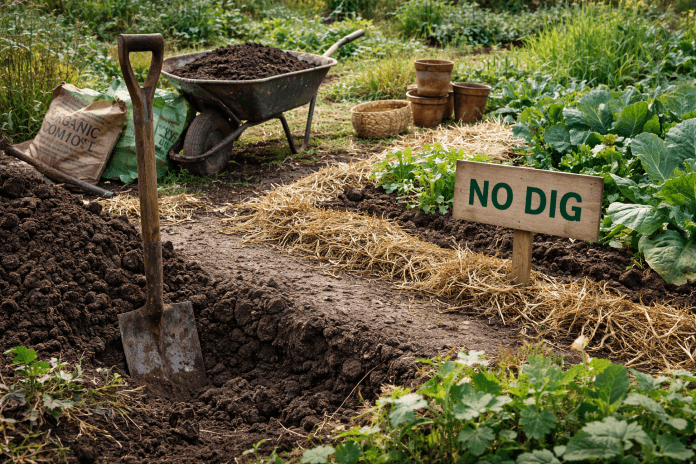
No-dig gardening has become one of the most fiercely defended ideas in modern horticulture. Question it, and you can expect raised eyebrows, sharp comments, and accusations of being “behind the times.” Suggest that digging might sometimes be necessary, and it can feel like heresy.
That alone should make gardeners uneasy.
No-dig is a method, not a belief system. And like all methods, it works brilliantly in some situations and poorly in others. The problem is not no-dig itself — the problem is the insistence that it is the only correct way to garden.
In real gardens, soil is not uniform. Some gardens sit on deep, friable loam that responds beautifully to mulching and minimal disturbance. Others are compacted clay, builder’s rubble, subsoil scraped bare by machinery, or ground that has been driven over, paved, flooded, and neglected for decades. Treating these soils as if they are all the same is not enlightened — it is careless.
Professional gardeners know this because they inherit the consequences. When no-dig fails, it fails slowly and expensively. Roots sit in anaerobic layers. Water lies where it shouldn’t. Plants sulk, then decline. And eventually, someone has to intervene — often with a spade — despite the theory.
What is rarely mentioned in no-dig evangelism is preparation. Many successful no-dig gardens begin with soil that was already workable, drained, and biologically active — or with an initial phase of cultivation that quietly goes unmentioned. The public message, however, skips straight to the mulch and promises results.
Gardening has always been about reading the ground in front of you. Digging was never done for pleasure. It was done because the soil demanded it. To dismiss all cultivation as destructive ignores decades of practical experience on difficult sites where roots simply cannot penetrate without help.
There is also a moral tone creeping into the conversation. Digging is framed as harmful. No-dig is framed as virtuous. This kind of language belongs in ideology, not horticulture. Soil does not respond to virtue. It responds to structure, drainage, oxygen, and biology.
None of this is an argument against no-dig. It is an argument against certainty. A gardener who refuses to dig under any circumstances is just as limited as one who reaches for a fork without thinking. Good gardening is responsive, not doctrinal.
The irony is that the best gardeners — past and present — rarely commit fully to one camp. They dig when they need to, mulch when they can, and adjust as conditions change. They watch what happens, then respond accordingly.
Perhaps the healthiest way to think about no-dig is this: it is a tool, not a truth. Use it where it works. Abandon it where it doesn’t. And be deeply suspicious of any gardening advice that claims one method can replace judgment.
Gardens are too complex, and soil too honest, to tolerate belief systems for long.