
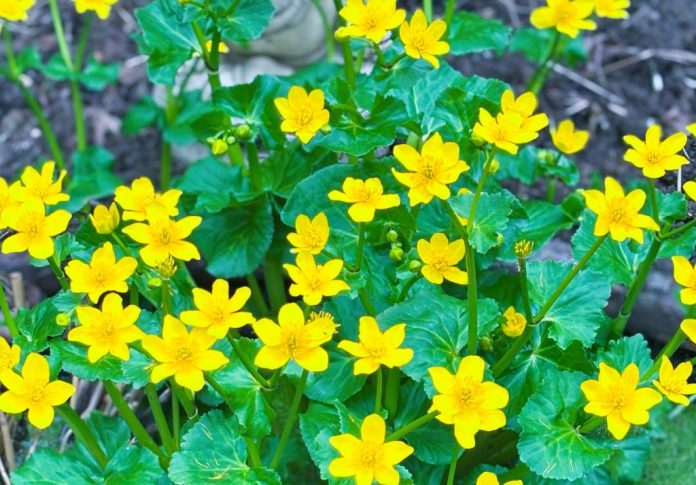
Marsh Marigold – Caltha palustris
Family: Ranunculaceae
Common Names: Marsh marigold, Kingcup, Cowflock, May blob
Botanical Synonyms: Caltha palustris var. radicans, Caltha palustris var. palustris
Botanical Description
Marsh marigold is a robust, herbaceous perennial native to temperate regions of Europe, Asia, and North America. It thrives in wetlands, fens, damp meadows, and shallow water margins.
- Habit: Clump-forming, with hollow, branching stems
- Height: Typically 30–60 cm
- Leaves: Glossy, kidney- or heart-shaped, with scalloped margins
- Flowers: Bright yellow, buttercup-like, 2.5–5 cm across; not true petals but petaloid sepals
- Bloom Time: March to May, often with a second flush in autumn
- Fruit: A cluster of follicles containing black seeds
Position & Growing Conditions
- Light: Full sun to part shade
- Soil: Consistently moist to wet, humus-rich, slightly acidic to neutral (pH 5.5–7)
- Moisture: Thrives in wet soil or shallow standing water up to 10 cm deep
- Location: Ideal at the edge of ponds, bog gardens, or stream margins
If your soil is too alkaline and you’re planting in the ground (not in a pond basket), you can:
- Add ericaceous compost
- Incorporate leaf mould or pine needle mulch
- Use sulphur chips or iron sulphate to gradually lower the pH
Temperature & Hardiness
- Hardy in RHS Zones: H7 – very hardy, tolerates temperatures down to -20°C or lower
- Climate Suitability: Perfect for the UK and other temperate zones
- Frost Tolerance: Fully frost-hardy; dies back in winter and regrows in spring
Care & Maintenance
General Care:
- Cut back old foliage in late autumn or early spring before new growth appears
- Remove spent flowers to encourage a second flush (optional)
- Divide congested clumps every 3–5 years to maintain vigour
Feeding:
- Not usually required if planted in fertile soil or aquatic planting media
- Can benefit from a spring mulch of compost or leaf mould around the crown
Pests & Diseases:
- Generally pest-free
- Slugs may nibble young shoots, but damage is rarely serious
- Avoid waterlogged, stagnant conditions to reduce risk of rot
Pruning
- When: Late autumn (after flowering) or early spring
- How: Cut back stems to ground level before new growth emerges
- Optionally deadhead in spring to prolong bloom
Propagation
Division:
- Best method for reliable results
- When: Spring or autumn
- How: Lift clumps, tease apart rooted sections with several shoots, and replant immediately
Seed:
- Sow fresh seeds in autumn or early spring
- Requires moist conditions and light for germination
- May take 1–2 years to flower from seed
Planting in a Pond or Bog Garden
In a Pond:
- Plant in aquatic baskets filled with loam-based compost (e.g., John Innes No. 2)
- Top with gravel to prevent soil washing out
- Position at the pond margin (shelf) with crown just above water, up to 10 cm deep
- Weigh basket with stone if necessary to keep stable
In a Bog Garden:
- Ensure permanent moisture—ideal with a liner or where water collects naturally
- Plant directly into the soil, spaced 30–40 cm apart
- Mulch annually to maintain soil condition
Garden Uses
- Wildlife ponds (attracts pollinators and amphibians)
- Bog gardens and damp meadows
- Naturalising in shady, wet areas
- Pairs well with Iris pseudacorus, Primula japonica, and Ligularia species
Toxicity
- All parts are mildly toxic if ingested raw; contains protoanemonin
- Sap may cause skin irritation in sensitive individuals—wear gloves when handling
Marsh Marigold – Caltha palustris Grow Guide
Common name: Marsh Marigold, Kingcup
Family: Ranunculaceae
Type: Hardy perennial
Hardiness: RHS H5 – fully hardy in the UK
Ultimate size: 30–60 cm tall × 30–50 cm wide
Overview
Marsh Marigold is a vivid spring-flowering perennial that thrives in wet or boggy conditions, making it ideal for pond edges, damp meadows, or rain gardens. It produces bright yellow buttercup-like flowers in early spring, often before the leaves fully emerge. Its lush, glossy green foliage provides structure throughout the growing season.
Position
- Light: Full sun to partial shade
- Performs best in wet or consistently damp soil
- Ideal for pond margins, wet woodland, or rain gardens
Soil
- Type: Moist, humus-rich, poorly-draining soil tolerated
- Can grow in waterlogged conditions, even in shallow standing water
- pH: Neutral to slightly acidic
Planting
- When: Spring or autumn
- Space plants 30–50 cm apart for clump formation
- Plant crowns slightly above soil level in standing water, or at soil edge for damp gardens
Watering
- Keep soil constantly moist during growth
- Tolerates shallow water around roots
- Avoid letting the soil dry out completely
Feeding
- Low-maintenance; rarely needs fertiliser
- Optional liquid feed in spring can encourage robust growth
Growth & Habit
- Clump-forming perennial with rounded, kidney-shaped, glossy leaves
- Flower stems rise 30–60 cm above foliage
- Spreads gradually via rhizomes, forming dense colonies
- Leaves may die back in late summer if conditions dry
Flowering
- Months: March–May (UK)
- Flowers: Bright yellow, buttercup-like, 3–5 cm across
- Early nectar source for bees and other pollinators
Maintenance
- Remove dead foliage after summer die-back
- Divide clumps every 3–4 years to rejuvenate growth
- Mulch in winter in exposed positions to protect roots
Propagation
- Division: Main method; divide clumps in autumn or early spring
- Seed: Possible; sow fresh in damp soil in spring
- Rhizome offsets: Can be used to spread plants along pond edges
Pests & Problems
- Generally pest- and disease-free
- Slugs may occasionally nibble young shoots
- Root rot if water is stagnant and oxygen-poor
Garden Use
- Pond and stream margins
- Bog or wet woodland gardens
- Rain gardens and wildlife-friendly planting
- Excellent companion plants:
- Iris pseudacorus (Yellow Flag Iris)
- Gunnera manicata
- Astilbe
- Lysichiton americanus (Skunk Cabbage)
Quick Reference Table
| Feature | Details |
|---|---|
| Hardiness | RHS H5 – fully hardy |
| Height | 30–60 cm |
| Spread | 30–50 cm |
| Flowering | March–May; bright yellow buttercup-like flowers |
| Position | Full sun to partial shade; damp or wet soil |
| Soil | Moist, humus-rich; tolerates waterlogged conditions; neutral to slightly acidic |
| Water | Keep soil constantly moist; tolerates shallow water |
| Feeding | Low-maintenance; optional spring liquid feed |
| Propagation | Division (main); seed; rhizome offsets |
| Maintenance | Remove dead foliage; divide every 3–4 years; mulch in winter |
| Best feature | Early bright yellow flowers and wetland foliage; excellent for pond edges |