
The Newspaper For Gardeners

Looking Out for Hedgehogs...

Hedgehogs are some of the most endearing creatures in our gardens, but winter...

Prune Apple Trees

Pruning is an essential task for maintaining healthy, productive apple trees. Proper pruning...

Dividing Snowdrops: A Step-by-Step...

Snowdrops (Galanthus spp.) are a cherished sight in late winter, heralding the arrival...

Force Rhubarb: A Gardener’s...

Forcing rhubarb is a traditional gardening technique that produces tender, sweet stalks, perfect...
Friday, January 16, 2026
A-ZBlackleg

Blackleg

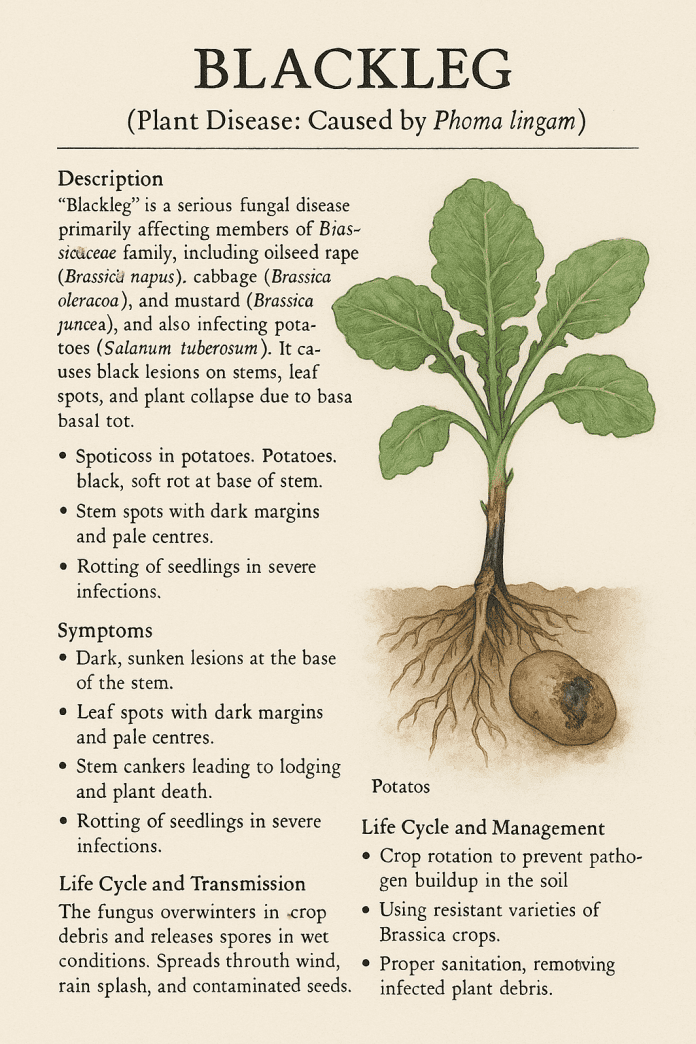
Blackleg (Plant Disease: Caused by Phoma lingam and Pectobacterium atrosepticum)

Classification:

  • Kingdom: Fungi / Bacteria
  • Phylum: Ascomycota (Phoma lingam) / Proteobacteria (Pectobacterium atrosepticum)
  • Class: Dothideomycetes (Phoma lingam) / Gammaproteobacteria (Pectobacterium atrosepticum)
  • Order: Pleosporales (Phoma lingam) / Enterobacterales (Pectobacterium atrosepticum)
  • Family: Didymellaceae (Phoma lingam) / Pectobacteriaceae (Pectobacterium atrosepticum)
  • Genus: Phoma / Pectobacterium
  • Species: Phoma lingam (syn. Leptosphaeria maculans) / Pectobacterium atrosepticum

Description:

Blackleg is a plant disease affecting members of the Brassicaceae family and potatoes (Solanum tuberosum). In brassicas, it is caused by the fungal pathogen Phoma lingam, while in potatoes, it is caused by the bacterial pathogen Pectobacterium atrosepticum. Both forms of the disease can lead to plant collapse and significant yield losses.

Symptoms:

Brassicas (Caused by Phoma lingam)
  • Dark, sunken lesions at the base of the stem, often girdling the plant.
  • Leaf spots with dark margins and pale centres, sometimes forming a “target” pattern.
  • Cankers on stems leading to structural weakness and lodging.
  • Seedling rot in early infections, causing plant death before maturity.
Potatoes (Caused by Pectobacterium atrosepticum)
  • Black, soft, and slimy rot at the base of potato stems.
  • Wilting and yellowing of foliage.
  • Tuber infection leading to soft rot.

Life Cycle and Transmission:

Brassicas:

Phoma lingam survives in plant debris and soil, releasing spores under wet conditions. The fungus spreads through wind, rain splash, and contaminated seeds. Infection often begins in autumn or spring when humidity and temperature favour fungal growth. Once established, the disease progresses systemically through the plant.

Potatoes:

Pectobacterium atrosepticum spreads through infected seed potatoes, contaminated soil, and water. The bacteria enter through wounds or natural openings, thriving in wet, poorly drained conditions.

Control and Management:

For Brassicas:
  • Crop Rotation: Avoid planting Brassica crops in the same field for consecutive seasons to reduce fungal buildup.
  • Resistant Varieties: Use cultivars bred for blackleg resistance.
  • Sanitation: Remove and destroy infected plant debris to limit spore production.
  • Fungicides: Apply fungicides at key growth stages if conditions favour disease development.
  • Seed Treatment: Use certified disease-free seeds and consider seed treatments to reduce early infection risk.
For Potatoes:
  • Seed Selection: Use certified disease-free seed potatoes to prevent infection.
  • Soil and Water Management: Ensure good drainage to reduce bacterial spread.
  • Hygiene: Clean equipment and avoid handling plants when wet.
  • Crop Rotation: Rotate potatoes with non-host crops to break the disease cycle.

Conclusion:

Blackleg is a destructive disease that can severely impact Brassica and potato yields. Integrated disease management, combining cultural practices, resistant varieties, and targeted control measures, is essential for effective prevention and mitigation.

spot_img

lOOKING FOR MORE WORK?

The free and easy way to get more customers. Just join Find Local Gardeners.

Canna viruses are a group of plant viruses that can infect and cause diseases in cannas, which are popular ornamental plants known for their...
If your Washingtonia robusta leaves are turning yellow, there could be several reasons behind this issue. Here are some common factors that can contribute...
Does Hollyhock Rust Spread to Other Plants? Hollyhock rust is one of the most common and frustrating diseases gardeners encounter when growing hollyhocks. The appearance...
How to diagnose, prevent and treat Box Blight and Box Tree Caterpillar in accordance with UK law Box hedges (Buxus sempervirens and related species) have...
BoltingCategory: Plant Physiology / Growth Disorders Definition:Bolting is the premature production of a flowering stem in plants before the crop has been harvested, typically triggered...

Enjoy February at Kew Gardens and Wakehurst

Orchid festival opens 7 February, pre-booking essential Continuing exhibitions in the Shirley Sherwood Gallery celebrate Indian art Horticultural highlights include snowdrops and delicate Alpine blooms Shaun the Sheep AR Trail arrives at Wakehurst for half-term Coming soon: Sounds of Blossom at Kew Gardens Kew...

Mountfield and the Big Garden Tidy Up

It is most definitely storm season! But don't let the tempests of this life get in the way of a nice, neat outside space.  Blowing a hooley could be just the thing you and your garden need for a...

‘Travel’s a breeze with Kubota RTV’s’ says Blairgowrie Golf Club

How do you quickly and easily navigate over 300 acres of Championship golf course, ensuring that people and materials are always exactly where you need them? Well, if you’re the greenkeeping team working across the 45-holes at Blairgowrie Golf...

I’ve Been Gardening Since the 1970s — and I Don’t Recognise Modern Advice

I started gardening in the 1970s, when advice was simple, local, and often passed on by someone who had made the mistakes before you. You learned by watching plants fail, succeed, and surprise you. You learned by turning up...

Continue reading

I’ve Been Gardening Since the 1970s — and I Don’t Recognise Modern Advice

I started gardening in the 1970s, when advice was simple, local, and often passed on by someone who had made the mistakes before you. You learned by watching plants fail, succeed, and surprise you. You learned by turning up...

No-Dig Is Not a Religion

No-dig gardening has become one of the most fiercely defended ideas in modern horticulture. Question it, and you can expect raised eyebrows, sharp comments, and accusations of being “behind the times.” Suggest that digging might sometimes be necessary, and...

Why Cheap Prices Attract Broke Customers – And Why That’s a Problem at Price Rise Time

As price rise season approaches, many small businesses feel the pressure to hold their prices down. There’s a fear that increasing prices will drive customers away, especially in tough economic times. But there’s an uncomfortable truth that needs saying: Cheap...

SUBSCRIBE TO OUR YOUTUBE CHANNEL

Plant advice for unusual species plus updates from our tropical garden

SUBSCRIBE