
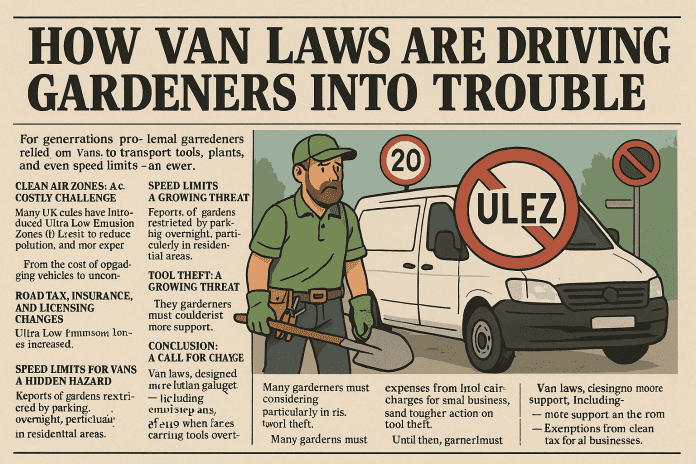
For generations, professional gardeners have relied on vans to transport tools, plants, and materials. But in recent years, changes in emissions laws, parking restrictions, licensing, and even speed limits have made running a gardening business more complicated—and more expensive—than ever.
From the cost of upgrading vehicles to unexpected fines, many gardeners now find that staying on the road is a constant challenge.
Clean Air Zones: A Costly Challenge
Many UK cities have introduced Ultra Low Emission Zones (ULEZ) and Clean Air Zones (CAZ) to reduce pollution. These zones target older diesel vans, which are common among self-employed gardeners.
- London’s ULEZ covers all boroughs, charging £12.50 per day for vans that do not meet emissions standards.
- Other cities, including Birmingham, Bristol, and Sheffield, have introduced similar zones, with daily charges of up to £9.
- Some councils, such as Oxford and Newcastle, have stricter Zero Emission Zones (ZEZ), where only electric vehicles are exempt from charges.
For many gardeners, upgrading to a newer, compliant van is simply not affordable. A second-hand, ULEZ-compliant van can cost upwards of £10,000, while brand-new models can be £30,000 or more.
Road Tax, Insurance, and Licensing Changes
The financial burden doesn’t stop at clean air charges. Vehicle Excise Duty (road tax) for vans has also increased. As of 2025, most diesel vans pay a flat rate of £320 per year, while electric vans are currently exempt. However, the government has announced that electric vans will be taxed from 2025.
Insurance costs have also risen, particularly for high-risk trades where vans are frequently targeted by thieves. Some insurers now charge extra for vans carrying tools overnight, leading many gardeners to invest in additional security.
Licensing and Weight Restrictions
For those carrying bulk loads of soil, compost, gravel, or logs, weight limits are another issue.
- 3.5-Tonne Rule: Most standard driving licences (Category B) allow vans up to 3.5 tonnes fully loaded. However, if a van and its load exceed this weight, the driver may need a Category C1 licence, which requires extra training and costs around £1,000 to obtain.
- Trailer Towing Rules: New drivers who passed their test after 1997 previously had to take an extra test to tow a trailer, but as of 2021, this requirement was scrapped. However, a trailer over 3.5 tonnes still requires a different licence.
Many gardeners unintentionally overload their vans, especially when carrying waterlogged soil, paving slabs, or full tool kits, risking fines and invalid insurance.
Vehicle Weights and Licensing in the UK
When driving larger vehicles in the UK, it’s important to understand different weight limits and the types of licences required. Here’s a breakdown:
1. Key Weight Terms
- Unladen Weight – The weight of the vehicle without passengers, goods, or fuel.
- Kerb Weight – The weight of the vehicle with a full tank of fuel, oil, and coolant, but without passengers or cargo.
- Gross Vehicle Weight (GVW) / Maximum Authorised Mass (MAM) – The maximum weight of the vehicle when fully loaded, including passengers and cargo. This is set by the manufacturer.
- Axle Weight – The weight transmitted to the ground by a single axle. It’s important for avoiding overloading and for road safety.
- Train Weight (Gross Train Weight, GTW) – The combined maximum weight of a vehicle and its trailer when fully loaded.
- Payload – The total weight the vehicle can legally carry, calculated as MAM minus the unladen weight.
2. Driving Licence Categories
Your driving licence determines the weight of vehicles you can legally drive:
UK Driving Licence Rules for Driving & Towing (2025)
Here’s a clear breakdown of what you can drive and tow on each UK licence category, with recent law changes highlighted.
🚗 Category B (Standard Car Licence)
What you can drive:
✅ A car or van up to 3,500kg MAM (Maximum Authorised Mass).
What you can tow:
✅ Trailer up to 3,500kg MAM (law changed in December 2021 – no test needed anymore).
✅ Combined weight depends on the vehicle’s towing capacity.
🔹 Before Dec 2021, drivers who passed after 1st Jan 1997 had to take a test to tow over 750kg. This rule has now been scrapped.
🚗 Category BE (Car + Trailer Licence)
What you can drive:
✅ Same as Category B (car or van up to 3,500kg MAM).
What you can tow:
✅ Trailers over 750kg MAM, subject to the vehicle’s towing capacity.
✅ No extra test needed since December 2021.
🔹 This category used to require a separate trailer test, but now Category B covers the same towing limits.
🚛 Category C1 (Small Lorries & Large Vans)
What you can drive:
✅ A vehicle between 3,500kg – 7,500kg MAM (e.g., larger vans, small trucks).
What you can tow:
✅ A 750kg trailer max.
🔹 Drivers who passed before 1st January 1997 automatically have C1 on their licence. If you passed after this date, you must take a C1 test.
🚛 Category C1E (Larger Vehicles + Heavy Towing)
What you can drive:
✅ A 3,500kg – 7,500kg MAM vehicle.
What you can tow:
✅ A trailer over 750kg (combined weight must not exceed 12,000kg MAM).
🔹 Before 1997, drivers automatically got C1E (with a combined limit of 8,250kg).
🔹 Now, new drivers must take a test for this category.
🚚 Category C (Large Goods Vehicles – LGV/HGV)
What you can drive:
✅ Any large vehicle over 3,500kg MAM (e.g., lorries, HGVs).
What you can tow:
✅ A 750kg trailer max (for heavier trailers, you need C+E).
🔹 A Driver CPC qualification is required for professional drivers.
🚚 Category CE (HGV + Large Trailer Licence)
What you can drive:
✅ Any large goods vehicle (HGVs, articulated lorries).
What you can tow:
✅ Any size trailer.
🔹 Required for HGV drivers towing large trailers.
🔹 A Driver CPC qualification is required for professional driving.
Speed Limits for Vans: A Hidden Hazard
Unlike cars, vans in the UK have lower speed limits on many roads, which some drivers may not realise.
- Single carriageways: 50 mph (instead of 60 mph for cars).
- Dual carriageways: 60 mph (instead of 70 mph for cars).
- Motorways: 70 mph (same as cars).
Speed Limits for Car-Derived Vans (CDVs)
- 60 mph on single carriageways (instead of 50 mph for regular vans)
- 70 mph on dual carriageways (instead of 60 mph for regular vans)
- 70 mph on motorways (same as regular vans)
To qualify as a car-derived van, the vehicle must:
✔ Be based on a car chassis
✔ Weigh under 2 tonnes when fully loaded (gross weight)
If a van is over 2 tonnes when fully loaded, it must follow the lower van speed limits.
Drivers caught exceeding these limits can face £100 fines and three penalty points.
Modern speed cameras can tell if you are driving a van or a car. Here’s how:
How Speed Cameras Detect Vans vs. Cars
- Automatic Number Plate Recognition (ANPR) – Speed cameras cross-check your number plate with the DVLA database, which lists your vehicle type, weight, and classification. This allows the system to apply the correct speed limit for your vehicle.
- Vehicle Size & Shape Detection – Some advanced cameras, especially HADECS 3 (Highways Agency Digital Enforcement Camera System) and SPECS average speed cameras, use radar and infrared sensors to measure a vehicle’s size, height, and profile.
- Different Speed Limit Triggers – Certain cameras, like Gatso and Truvelo, have different thresholds for triggering depending on whether the vehicle is a car, van, or lorry.
What This Means for Van Drivers
- If you’re driving a car-derived van (CDV) under 2 tonnes, the camera will recognize it as a car and apply car speed limits.
- If you’re in a larger van (over 2 tonnes fully loaded), the camera will apply the lower van speed limits.
- If you’re towing a trailer, the system can still detect this in some cases, especially with motorway overhead cameras.
Bottom Line: Speed cameras can detect if you’re in a van and enforce the correct speed limit accordingly! 🚛📸
Parking Restrictions and Overnight Bans
Parking is another growing concern. Many councils now restrict where vans can be parked overnight, particularly in residential areas.
- Some councils issue parking permits for tradespeople, but these can be expensive.
- Multi-storey and city centre car parks often have height restrictions (usually 2m-2.2m), making them inaccessible to many vans.
Even temporary parking can be a problem. Some councils fine gardeners for parking in residential areas, even if they are working at a customer’s property.
Tool Theft: A Growing Threat
Van and tool theft is a major issue, with organised gangs targeting work vehicles. Some estimates suggest a van is broken into every 23 minutes in the UK.
Police advise removing tools overnight, but for many gardeners, this is impractical. Stolen tools can cost thousands to replace, and even with insurance, there’s the risk of increased premiums.
How Gardeners Are Fighting Back
- Installing dash cams and van alarms.
- Using steel tool safes inside vans.
- Parking in well-lit areas and using lockable wheel clamps.
The Future: Are Electric Vans the Answer?
With the government phasing out new diesel vans by 2035, many gardeners are considering electric vehicles (EVs). However, EVs come with challenges:
- High initial cost: Electric vans start at around £35,000.
- Limited range: Many models offer only 150-200 miles per charge, which may not be enough for mobile gardeners.
- Charging issues: Not all gardeners have off-street parking or easy access to charging points.
While electric vans will eventually become the norm, many gardeners believe the infrastructure and financial support need to improve before they can make the switch.
Conclusion: A Call for Change
Van laws, designed to reduce pollution and improve safety, are making life harder for gardeners. Many are calling for more support, including:
- Financial assistance for tradespeople forced to upgrade their vans.
- Exemptions from clean air charges for small businesses.
- Tougher action on tool theft.
Until then, gardeners must navigate a growing maze of regulations just to keep their businesses on the road.