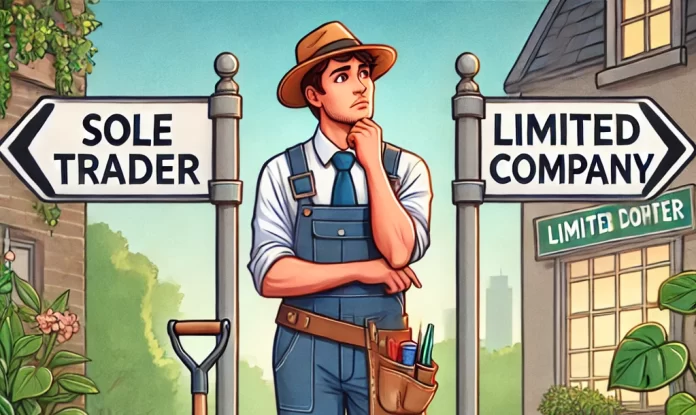
If you’re starting a gardening business, one of the first decisions you’ll need to make is whether to operate as a sole trader or a limited company. Each has its pros and cons, and the best choice depends on your goals, financial situation, and how you want to manage your business.
This article will break down the differences between these two business structures and help you decide which is right for you.
1. What is a Sole Trader?
A sole trader is a self-employed individual who runs their business alone. It’s the simplest and most common business structure for gardeners, landscapers, and other tradespeople.
Pros of Being a Sole Trader
✅ Easy to Set Up – You just need to register with HMRC for self-assessment.
✅ Lower Administrative Costs – No need for annual company filings or complicated paperwork.
✅ Full Control – You make all business decisions without answering to shareholders or directors.
✅ Simpler Taxation – You pay income tax via self-assessment, and there’s no corporation tax.
Cons of Being a Sole Trader
❌ Unlimited Liability – If your business owes money or gets sued, you’re personally responsible.
❌ Can Be Less Tax-Efficient – As your earnings grow, tax rates can be higher than a limited company.
❌ Less Credibility – Some larger clients prefer working with registered companies.
❌ Harder to Raise Funds – Banks and investors are more likely to lend to a limited company.
2. What is a Limited Company?
A limited company is a separate legal entity from its owner. This means that your personal finances are protected if the business has debts or legal issues. You’ll need to register your company with Companies House and follow more formal requirements.
Pros of Being a Limited Company
✅ Limited Liability – Your personal assets are protected if something goes wrong.
✅ Tax Benefits – Companies pay corporation tax (currently 19-25%), which can be lower than personal income tax for higher earners.
✅ More Professional Image – Many clients see limited companies as more trustworthy.
✅ Easier to Sell or Pass On – You can transfer ownership or sell shares in the future.
Cons of Being a Limited Company
❌ More Paperwork – You’ll need to file annual accounts, corporation tax returns, and keep detailed records.
❌ Higher Costs – Accountancy fees and registration costs are higher than for sole traders.
❌ Less Privacy – Your company details, including directors and financial records, are publicly available on Companies House.
❌ More Complexity – You must follow legal duties as a company director, such as keeping company finances separate from personal finances.
3. Tax Considerations: Sole Trader vs. Limited Company
- As a sole trader, you pay income tax on profits over the personal allowance (£12,570 in 2024/25) at:
- 20% (basic rate) on profits up to £50,270
- 40% (higher rate) on profits above £50,270
- 45% (additional rate) on profits over £125,140
- You also pay National Insurance contributions (NICs) on earnings.
- As a limited company, you pay corporation tax (19-25%) on profits. You can pay yourself a small salary (to reduce NICs) and take extra income as dividends, which are taxed at lower rates than income tax.
If your gardening business earns over £30,000 per year, it might be worth considering a limited company for tax savings.
4. Which is Right for You?
- Choose Sole Trader if:
✅ You’re just starting out and want to keep things simple.
✅ You don’t expect to earn much over £30,000 per year.
✅ You want to avoid extra paperwork and admin costs. - Choose a Limited Company if:
✅ You want to protect your personal assets from business risks.
✅ You plan to grow the business and take on bigger contracts.
✅ You expect to earn over £30,000-£40,000 per year and want to be tax-efficient.
5. How to Register as a Sole Trader or Limited Company
- Registering as a Sole Trader
- Sign up for Self-Assessment at gov.uk/register-self-assessment.
- Keep records of income and expenses.
- File a tax return each year.
- Registering a Limited Company
- Choose a company name and register it with Companies House at gov.uk/register-limited-company.
- Appoint at least one director and file company records yearly.
- Set up a business bank account.
- Register for corporation tax and PAYE (if paying yourself a salary).
Final Thoughts
Choosing between a sole trader and a limited company depends on how big you want your gardening business to grow. If you’re starting small, sole trader status is quick and simple. If you want protection from financial risk and tax benefits, a limited company might be the better long-term option.
If you’re unsure, speak to an accountant to see what’s best for your situation!