
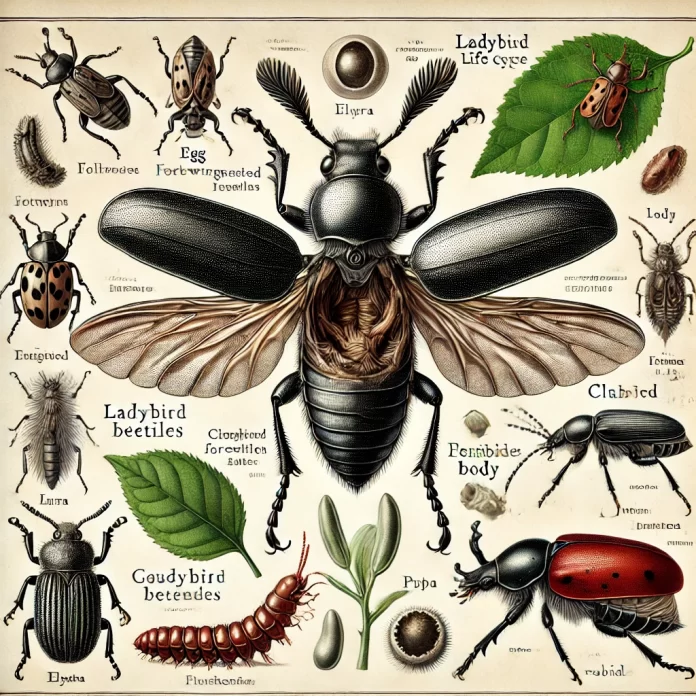
Beetle (Order: Coleoptera)
Taxonomy & Classification
- Kingdom: Animalia
- Phylum: Arthropoda
- Class: Insecta
- Order: Coleoptera
- Families: Over 350 (e.g., Scarabaeidae, Carabidae, Curculionidae, Coccinellidae)
Description
Beetles are the largest order of insects, with over 400,000 species described worldwide. They are distinguished by their hardened forewings (elytra), which protect the delicate hindwings used for flight.
- Size: Varies from less than 1 mm (Featherwing beetles) to over 150 mm (*Titan beetle, Titanus giganteus).
- Body Shape: Compact, segmented into head, thorax, and abdomen.
- Coloration: Can range from dull brown or black to iridescent blues, greens, and reds.
- Antennae: Highly variable, from simple filaments to clubbed or feathery structures.
Life Cycle
Beetles undergo complete metamorphosis (holometabolism) with four distinct stages:
- Egg – Laid in soil, wood, leaves, or inside host plants.
- Larva – Often called grubs, larvae are worm-like and adapted for burrowing or feeding on plants, fungi, or decaying matter.
- Pupa – A resting stage where transformation into the adult form occurs.
- Adult – Fully developed beetle emerges, ready to reproduce.
Ecological Roles
Beetles play crucial roles in ecosystems:
- Decomposers: Dung beetles (Scarabaeinae) recycle waste, while carrion beetles (Silphidae) break down dead organisms.
- Pollinators: Many species, like flower beetles (Cleridae), assist in pollination.
- Pest Controllers: Ladybirds (Coccinellidae) feed on aphids and scale insects.
- Seed Dispersers: Some beetles, such as weevils (Curculionidae), aid in seed distribution.
Common Families & Examples
- Ladybird Beetles (Coccinellidae) – Beneficial predators of aphids and scale insects.
- Ground Beetles (Carabidae) – Nocturnal hunters of pests in gardens and fields.
- Scarab Beetles (Scarabaeidae) – Includes dung beetles, vital for nutrient cycling.
- Weevils (Curculionidae) – Recognizable by their elongated snouts; many are agricultural pests.
- Longhorn Beetles (Cerambycidae) – Wood-boring larvae contribute to forest decomposition.
Habitats & Distribution
Beetles are found in almost every terrestrial habitat, from tropical rainforests to arid deserts and polar regions. They adapt to diverse environments, thriving in leaf litter, soil, under bark, and even in aquatic ecosystems.
Threats & Conservation
- Deforestation and habitat loss threaten many beetle species, particularly those reliant on specific plants or decaying wood.
- Pesticides reduce populations of beneficial beetles like ladybirds and ground beetles.
- Conservation efforts focus on preserving native habitats, reducing chemical use, and promoting sustainable agriculture.
Interesting Facts
- The Goliath beetle (Goliathus spp.) is one of the heaviest insects, weighing up to 100 grams.
- Fireflies (Lampyridae) are actually beetles, known for their bioluminescence.
- The bombardier beetle (Brachinus spp.) ejects a hot, noxious chemical spray to deter predators.
Would you like a beetle illustration to accompany this entry?