The Newspaper For Gardeners

Looking Out for Hedgehogs...

Hedgehogs are some of the most endearing creatures in our gardens, but winter...

Prune Apple Trees

Pruning is an essential task for maintaining healthy, productive apple trees. Proper pruning...

Dividing Snowdrops: A Step-by-Step...

Snowdrops (Galanthus spp.) are a cherished sight in late winter, heralding the arrival...

Force Rhubarb: A Gardener’s...

Forcing rhubarb is a traditional gardening technique that produces tender, sweet stalks, perfect...
Wednesday, January 7, 2026
A-ZAApple Blossom Weevil

Apple Blossom Weevil

Apple Blossom Weevil (Anthonomus pomorum)

Taxonomy:

  • Kingdom: Animalia
  • Phylum: Arthropoda
  • Class: Insecta
  • Order: Coleoptera
  • Family: Curculionidae
  • Genus: Anthonomus
  • Species: A. pomorum

Description:

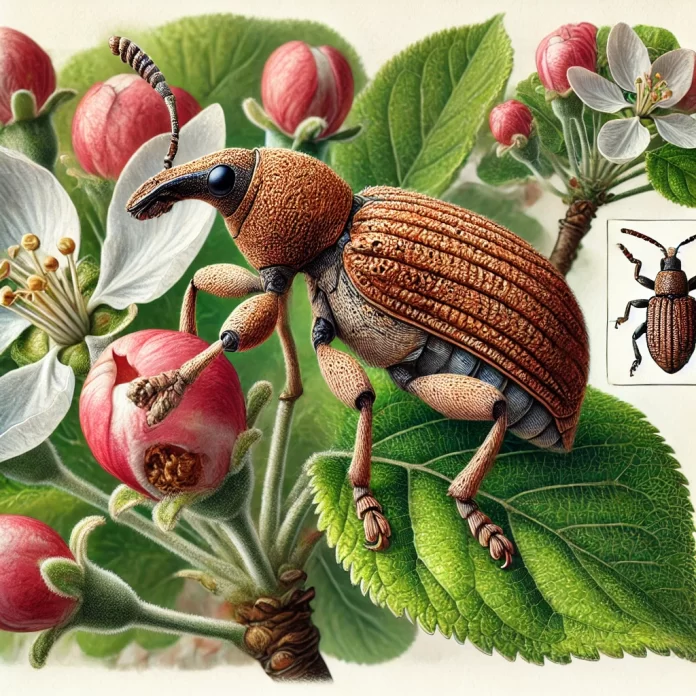
The Apple Blossom Weevil (Anthonomus pomorum) is a small, reddish-brown beetle belonging to the Curculionidae family. It measures approximately 3–4 mm in length and has a distinctive elongated snout, characteristic of true weevils. The body is covered in fine scales, giving it a slightly mottled appearance, and the legs are a darker brown. The antennae are clubbed and elbowed, aiding in the detection of floral buds.

Life Cycle & Development:

The weevil has a single generation per year. Adults overwinter in sheltered locations such as bark crevices, leaf litter, or the ground near host trees. In early spring, as temperatures rise, the beetles become active and migrate to apple (Malus domestica) trees, feeding on developing buds.

After mating, females lay eggs within the flower buds, often depositing one per bud. The larvae hatch inside the bud and feed on developing flower tissues, preventing them from opening. This damage leads to the formation of characteristic “brown cap” flowers, which fail to develop into fruit. The larvae pupate inside the damaged buds, emerging as adults in early summer before seeking overwintering sites.

Host Plants:

The primary host of A. pomorum is the domestic apple (Malus domestica), but it can also affect other species within the Malus and Pyrus (pear) genera.

Damage & Economic Impact:

The Apple Blossom Weevil is considered a pest in commercial apple orchards, as its larval feeding reduces fruit yield. Severe infestations can significantly impact crop production, especially in temperate regions where apple cultivation is prominent. The “brown cap” symptom, where dried, unopened flower buds remain on the tree, is a key sign of infestation.

Control & Management:

  • Cultural Control: Pruning and removing infested buds can help reduce populations. Encouraging natural predators, such as birds and parasitic wasps, may also aid in population control.
  • Mechanical Control: Monitoring and early intervention using sticky traps or physical removal of adult weevils can help limit damage.
  • Chemical Control: In commercial orchards, targeted insecticide applications may be used when adults first become active in spring. However, timing is crucial to avoid harming beneficial pollinators.
  • Biological Control: Natural enemies, including parasitoid wasps and predatory beetles, contribute to population suppression in balanced ecosystems.

Distribution & Habitat:

The Apple Blossom Weevil is widely distributed across Europe and parts of Asia. It thrives in temperate climates, particularly in regions with established apple orchards or wild Malus species. It prefers sheltered overwintering sites such as hedgerows, woodlands, and orchard margins.

Conservation Status:

Anthonomus pomorum is not considered endangered, though it is managed as an agricultural pest in apple-growing regions. Integrated Pest Management (IPM) strategies are recommended to minimize chemical use and preserve ecological balance.

Interesting Facts:

  • The weevil’s feeding damage often leads to reduced fruit set but can sometimes benefit trees by thinning excessive blooms, leading to larger, healthier fruit.
  • Its elongated snout is adapted for piercing buds and laying eggs inside them.
  • The “brown cap” symptom caused by larval feeding is a distinctive sign of infestation.

spot_img

lOOKING FOR MORE WORK?

The free and easy way to get more customers. Just join Find Local Gardeners.

How to diagnose, prevent and treat Box Blight and Box Tree Caterpillar in accordance with UK law Box hedges (Buxus sempervirens and related species) have...
BoltingCategory: Plant Physiology / Growth Disorders Definition:Bolting is the premature production of a flowering stem in plants before the crop has been harvested, typically triggered...
Definition:Blotchy ripening is a physiological disorder primarily observed in fleshy fruits—most notably in tomatoes (Solanum lycopersicum)—where patches of the fruit fail to develop normal...
Blossom End Rot (noun; plant pathology, horticulture) Definition: Blossom end rot is a physiological disorder affecting the fruit of various flowering plants—most notably tomatoes, peppers, aubergines...
Blind (adjective, noun; horticulture, botany) Definition (Botany & Horticulture): In a botanical or horticultural context, blind refers to a plant shoot, bud, or flowering stem that...

British Garden Centres welcomes Dronfield Garden Centre as its 74th site following Ferndale acquisition

British Garden Centres is delighted to announce the successful acquisition of Ferndale Garden Centre in North Derbyshire. The centre officially joined the group in early January and will now trade as Dronfield Garden Centre, bringing the group’s total number...

January Gardening Tips From Barnsdale Gardens

Christmas already feels like a long time ago, but the Barnsdale Gardens team hope you enjoyed it as much as they did! Never ready to rest on their laurels, the work doesn't stop when it comes to looking after...

Angus Thompson Creates a Garden to Breathe in at RHS Chelsea Flower Show 2026

The Asthma + Lung UK – Breathing Space Garden invites visitors to pause, breathe, and reconnect with themselves, each other, and nature. Award-winning garden designer Angus Thompson returns to RHS Chelsea Flower Show 2026 with the Breathing Space Garden, a...

GroundTech appointed as first UK Distributor for Drop-Pit

GroundTech is proud to announce its appointment as the first UK distributor for the revolutionary Drop-Pit Ball Management System, developed by VDB Technics – an industry leader in automated driving-range technology. Specifically developed to work in conjunction with robotic...

Continue reading

Tackling Box Blight and Box Tree Caterpillar Legally in the UK

How to diagnose, prevent and treat Box Blight and Box Tree Caterpillar in accordance with UK law Box hedges (Buxus sempervirens and related species) have long been a staple of British gardens — framing parterres, edging borders, and forming centuries-old...

Bolting

BoltingCategory: Plant Physiology / Growth Disorders Definition:Bolting is the premature production of a flowering stem in plants before the crop has been harvested, typically triggered by environmental stress. It is especially common in leafy vegetables such as lettuce (Lactuca sativa),...

Blotchy Ripening

Definition:Blotchy ripening is a physiological disorder primarily observed in fleshy fruits—most notably in tomatoes (Solanum lycopersicum)—where patches of the fruit fail to develop normal coloration during the ripening process. This results in irregular, often green, yellow, or grey-green areas...

SUBSCRIBE TO OUR YOUTUBE CHANNEL

Plant advice for unusual species plus updates from our tropical garden

SUBSCRIBE