
The Newspaper For Gardeners

December Gardening Tips From...

Ooohhhhh …it's nearly here…Christmas! A time for cosy evenings by the fire and...

Looking Out for Hedgehogs...

Hedgehogs are some of the most endearing creatures in our gardens, but winter...

Protecting Your Plants from...

Winter can be a challenging time for gardeners, particularly when wildlife like deer...

Winter Compost: Digging Out...

Winter is an excellent time to dig out your compost heap and spread...
Saturday, December 27, 2025
HomeAcid soilNarcissus (Daffodils)

Narcissus (Daffodils)

Plant Grow Guide: Narcissus (Daffodils)

Taxonomy

  • Scientific Name: Narcissus spp.
  • Family: Amaryllidaceae
  • Common Names: Daffodil, Narcissus, Jonquil

Origin

  • Native Range: Europe, North Africa, and Western Asia.

Plant Type

  • Type: Herbaceous perennial bulb

Position

  • Light: Full sun to partial shade
  • Exposure: Sheltered or exposed

Soil

  • Type: Well-drained, loamy or sandy soils
  • pH: Neutral to slightly acidic
  • Moisture: Moist but well-drained

Size

  • Height: 10 to 50 cm (4-20 inches), depending on variety
  • Spread: 10 to 15 cm (4-6 inches)

Hardiness

  • RHS Hardiness Rating: H6 (Hardy to -20 to -15°C)
  • USDA Zone: 3-8

When and How to Plant

  • When to Plant: Autumn, ideally September to November.
  • How to Plant:
    • Choose a sunny or partially shaded location with well-drained soil.
    • Plant bulbs 10-15 cm (4-6 inches) deep, pointed end up.
    • Space bulbs about 10 cm (4 inches) apart.
    • Water well after planting.

Flowering

  • When it Flowers: Late winter to late spring, typically from February to May depending on the variety.
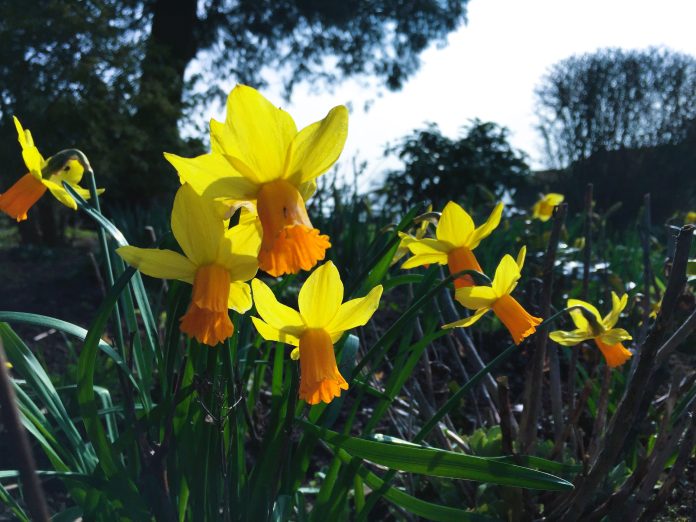
  • Description: Trumpet-shaped flowers with a central corona surrounded by petal-like tepals in shades of yellow, white, orange, or pink.

How and When to Prune

  • When to Prune: After flowering (late spring to early summer).
  • How to Prune:
    • Deadhead spent flowers to prevent energy going into seed production.
    • Allow foliage to die back naturally to replenish the bulb.
    • Remove yellowed or dead leaves to keep the area tidy.

How to Propagate

  1. Division:
    • Dig up clumps of bulbs in summer after the foliage has died back.
    • Separate offsets and replant immediately or store in a cool, dry place until autumn.
  2. Seeds:
    • Sow fresh seeds in autumn; note that seed propagation may take several years to produce flowering plants.

Pests and Diseases

  • Pests:
    • Narcissus bulb fly: Prevent by planting bulbs deeply.
    • Slugs and snails: Protect young shoots with barriers or organic treatments.
  • Diseases:
    • Basal rot: Avoid planting in poorly drained soils.
    • Virus infections: Destroy affected plants to prevent spread.

Best Varieties

  • Trumpet Daffodils: ‘King Alfred’, ‘Dutch Master’
  • Large-Cupped Daffodils: ‘Ice Follies’, ‘Carlton’
  • Small-Cupped Daffodils: ‘Barrett Browning’, ‘Dreamlight’
  • Double Daffodils: ‘Rip van Winkle’, ‘Cheerfulness’
  • Jonquils: ‘Baby Moon’, ‘Pipit’
  • Miniature Daffodils: ‘Tête-à-Tête’, ‘Minnow’

Companion Plants

  • Plants it Goes Well With:
    • Early spring bloomers like crocuses (Crocus spp.) and hyacinths (Hyacinthus spp.).
    • Groundcovers like creeping phlox (Phlox subulata) and ajuga (Ajuga reptans).
    • Perennials such as lungwort (Pulmonaria) and hellebores (Helleborus).

History and Interesting Facts

History

Daffodils have been cultivated for centuries and are deeply embedded in cultural history. They were prized by the ancient Romans for their medicinal properties and later became a symbol of renewal and hope in Christian iconography. In the UK, daffodils are particularly associated with Wales, where they are a national emblem and often worn on St. David’s Day.

Interesting Facts

  • The name “Narcissus” is derived from Greek mythology; it refers to the youth Narcissus, who fell in love with his reflection.
  • Daffodils are toxic if ingested, making them deer and rabbit resistant.
  • They produce a natural chemical, galantamine, which is used in the treatment of Alzheimer’s disease.
  • The “Tenby daffodil” (Narcissus pseudonarcissus subsp. obvallaris) is native to the UK and found primarily in Wales.
  • Daffodils symbolize new beginnings and are often used in springtime celebrations and floral arrangements.

Additional Care Tips

  • Water daffodils during dry spells in spring and early summer to ensure the bulbs store enough energy for the next season.
  • Apply a low-nitrogen fertilizer after flowering to promote healthy bulb development.
  • Avoid cutting foliage too early, as this can reduce the plant’s vigor.

This guide ensures that your daffodils will brighten your garden year after year with minimal effort!

spot_img

lOOKING FOR MORE WORK?

The free and easy way to get more customers. Just join Find Local Gardeners.

Bromeliads are often associated with steamy rainforests and exotic holiday destinations, yet many can be grown very successfully in the UK. With their sculptural...
Botanical Name: Verbena bonariensis L. Synonyms: Verbena patagonica Gillies & Hook. ex Hook.Family: VerbenaceaeCommon names: Purpletop vervain, Tall verbena, Argentinian vervainPlant type: Short-lived perennial (self-seeds...
🌺 Dahlia Fact Sheet Botanical name: Dahlia spp.Family: Asteraceae (same as sunflowers, daisies, zinnias)Origin: Native to Mexico and Central America. First introduced to Europe in...
Tithonias, commonly known as Mexican sunflowers, are a vibrant addition to UK gardens. With their fiery orange-red blooms and striking stature, these tender annuals...
Alstroemeria, commonly known as the Peruvian lily or lily of the Incas, is a versatile and long-lasting perennial that has become a favourite in...

Defra Ministers appoint Sir Andrew Steer as Chair of the Board of Trustees of the Royal Botanic Gardens, Kew 

Monday, 22 December 2025 Sir Andrew Steer, a prominent global leader in sustainable development and climate change has been announced as the new Chair of RBG Kew, taking over from Dame Amelia Fawcett who held the post for two terms.    Sir Andrew’s appointment is for four years and...

BigPlantPots: Bold Design, Built for Growing Big

As gardeners continue to embrace statement planting and flexible outdoor design, one UK brand is helping both professionals and home growers think bigger. BigPlantPots specialises in oversized plant containers that combine strong visual design with serious growing capacity, making...

Green-tech ends the year on a high by surpassing its charity target for St Leonard’s Hospice

Green‑tech is delighted with the success of its 2025 charity fundraising campaign for St Leonard’s Hospice, York. Their efforts have raised over £1,600. Green‑tech is the UK’s leading landscape provider, supplying products that help create greener, more resilient and biodiverse spaces...

Conservation of Scotland’s rarest moss boosted by Air-Pot® innovation

THE TEAM at Royal Botanic Garden Edinburgh (RBGE) has been able to successfully cultivate one of Scotland’s rarest mosses – Round‑leaved bryum – during ex‑situ conservation trials with the help of Air-Pot® (December 2025). The Air-Pot container’s innovative design, which...

Continue reading

Defra Ministers appoint Sir Andrew Steer as Chair of the Board of Trustees of the Royal Botanic Gardens, Kew 

Monday, 22 December 2025 Sir Andrew Steer, a prominent global leader in sustainable development and climate change has been announced as the new Chair of RBG Kew, taking over from Dame Amelia Fawcett who held the post for two terms.    Sir Andrew’s appointment is for four years and...

BigPlantPots: Bold Design, Built for Growing Big

As gardeners continue to embrace statement planting and flexible outdoor design, one UK brand is helping both professionals and home growers think bigger. BigPlantPots specialises in oversized plant containers that combine strong visual design with serious growing capacity, making...

Green-tech ends the year on a high by surpassing its charity target for St Leonard’s Hospice

Green‑tech is delighted with the success of its 2025 charity fundraising campaign for St Leonard’s Hospice, York. Their efforts have raised over £1,600. Green‑tech is the UK’s leading landscape provider, supplying products that help create greener, more resilient and biodiverse spaces...

SUBSCRIBE TO OUR YOUTUBE CHANNEL

Plant advice for unusual species plus updates from our tropical garden

SUBSCRIBE